Website Traffic Isn’t Enough: How to Turn Visits into Customers in Tourism and Food Industries
Website traffic alone is not enough, tourism conversions and restaurant marketing are the real challenges many operators struggle to solve. In this article, I explain why having visitors does not mean making sales and how to turn traffic into real customers with practical strategies you can apply immediately in travel and food.
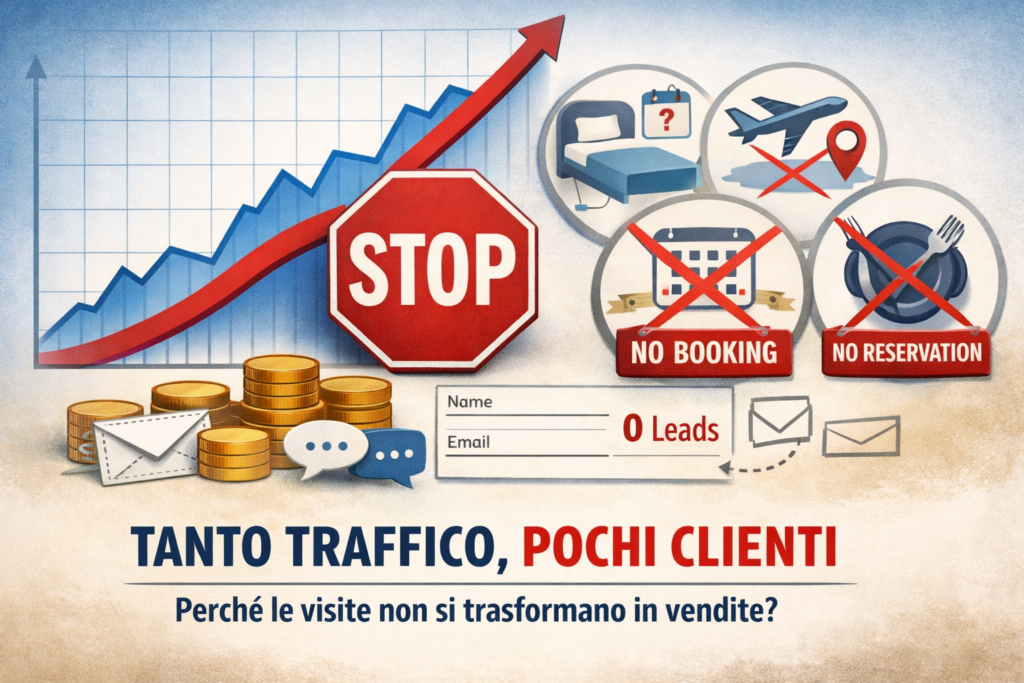
In recent years, I’ve watched an obsession grow: traffic. More visits, more users, more numbers to show. But there is a truth that few have the courage to say (and it often hurts):traffic, on its own, is useless. You can have thousands of users on your site every month, but if they don’t become leads, clients, or bookings, you’re simply fueling an empty metric. And this happens much more often than you’d think, especially in tourism and food.
Summary
It’s a subtle mechanism. The traffic grows, the charts are up, and everything seems to be going in the right direction. But then you look at the real results: few inquiries, few conversions, few sales. And that’s where the frustration starts. Because the truth is simple (and uncomfortable):visibility and results are not the same thing.
The traffic myth: numbers that reassure, but don’t lead to growth
Traffic is easy to show. It’s a number that increases, that’s satisfying, that can impress. But it doesn’t tell the truth. In tourism and hospitality, this mistake is even more common. Guides, articles, blogs, informative content: all of these bring users. But often, there’s a complete disconnect from the business.
The real question we should ask is this:how many of these people are actually doing something useful for your business?Do they book? Do they write? Do they request information? Do they come back? If the answer is no, that traffic is just passing through. Not value. And above all: it’s traffic you don’t control. It comes and goes, without leaving anything behind.
Where value is lost: common mistakes in tourism and hospitality
In my work, I always see the same problems, even on projects with great visibility.
Informational content without direction: articles that bring traffic but don’t guide the user
Lack of call to action: no clear invitation to take action
Weak user experience: sites that are slow, confusing, or unclear
Unmanaged international traffic: users from other countries with no conversion strategy
No contact collection: the user comes and goes, leaving no trace
To these, you can add an even deeper mistake:the lack of a path. Many sites are simply a collection of content. Well-done, even. Well-ranked, too. But there is no logical thread guiding the user. They read, scroll, leave. And every exit is a missed opportunity.
The key step: from visitor to contact
The real leap isn’t increasing traffic. It’sturning the visitor into something more. A contact. An inquiry. A booking. This step only happens when there’s a strategy. It’s not automatic, it’s not random, and above all it doesn’t depend only on SEO. SEO brings people. Strategy transforms them. And this is where the difference is made between those who “create content” and those who build a system.
The strategies that really work (and you can apply right away)
You don’t need revolutions. You need precise choices.
1. Add real call to actions
Every piece of content must have a purpose. Even a simple invitation to contact you can make a difference. But it must be clear, visible, and consistent with what the user is reading. A generic CTA doesn’t work. A contextual CTA does.
2. Write content with intent
Intercepting a keyword is not enough. You have to guide the user toward a decision. If someone searches for “things to do in Milan,” they don’t just want to read: they want to get oriented, choose, and decide. And you need to be there at that moment.
3. Value international traffic
If you get visits from multiple countries (as often happens in tourism), you need to ask yourself: am I offering a path suitable for them too? Language, trust, ways to get in touch: everything must be designed for a global audience. Otherwise, you miss out on huge opportunities.
4. Create points of contact
Forms, email, quick requests: every user must have an easy way to get in touch with you. And above all: you need to give them a reason to do it.
5. Build an ecosystem, not single pieces of content
A single article rarely converts. But a system of related, consistent, and targeted content does. Clusters, guides, in-depth resources: everything must lead somewhere.
A concrete example: when traffic becomes opportunity
Working on multilingual projects in tourism, I’ve seen one thing clearly: traffic grows when content is well structured. But value only comes when there’s a strategy behind it. Translating content into multiple languages, for example, can hugely increase visits. But without a conversion system, that traffic just gets lost.
It’s a mistake I see often: major investments in visibility, zero focus on conversion. But when you build a path (content, trust, contact), the results change completely. Requests go up. Opportunities become concrete. And traffic stops being just a number and becomes an asset.
Conclusion: less traffic, more strategy
You don’t need more traffic. You need to do something with what you have. That’s where the difference lies between a website that simply “works” and one that truly generates value. If you’re getting visits but not seeing real results, the problem is probably not visibility, but strategy.
And here’s the good news: it’s a problem you can solve. If you want to analyze your situation and see where you may be missing opportunities, you can request a free consultation. Together, we’ll look at numbers, content, and real growth opportunities.
Frequently Asked Questions
Why isn’t having traffic on your site enough?
Having traffic means attracting visitors, but it doesn’t guarantee real results. Without a conversion strategy, users read and then leave without becoming customers or contacts.
How do you turn traffic into customers in tourism and food?
You need to guide users with strategic content, include effective call to actions, improve the site experience, and create contact points like forms or quick-request options.
What is the most common mistake in tourism and restaurant sites?
The most widespread mistake is creating informational content that brings traffic but doesn’t guide users toward a decision or concrete action.
Is international traffic useful for business?
Yes, but only if managed correctly. Without adapted content, proper language, and conversion paths, international traffic risks not generating any results at all.
How do I know if my site really converts?
You need to analyze metrics such as contact requests, bookings, time on site, and user return rate—not just the number of visits.
Usiamo cookie per ottimizzare il nostro sito web ed i nostri servizi.
Funzionale
Always active
L'archiviazione tecnica o l'accesso sono strettamente necessari al fine legittimo di consentire l'uso di un servizio specifico esplicitamente richiesto dall'abbonato o dall'utente, o al solo scopo di effettuare la trasmissione di una comunicazione su una rete di comunicazione elettronica.
Preferenze
L'archiviazione tecnica o l'accesso sono necessari per lo scopo legittimo di memorizzare le preferenze che non sono richieste dall'abbonato o dall'utente.
Statistiche
L'archiviazione tecnica o l'accesso che viene utilizzato esclusivamente per scopi statistici.L'archiviazione tecnica o l'accesso che viene utilizzato esclusivamente per scopi statistici anonimi. Senza un mandato di comparizione, una conformità volontaria da parte del vostro Fornitore di Servizi Internet, o ulteriori registrazioni da parte di terzi, le informazioni memorizzate o recuperate per questo scopo da sole non possono di solito essere utilizzate per l'identificazione.
Marketing
L'archiviazione tecnica o l'accesso sono necessari per creare profili di utenti per inviare pubblicità, o per tracciare l'utente su un sito web o su diversi siti web per scopi di marketing simili.