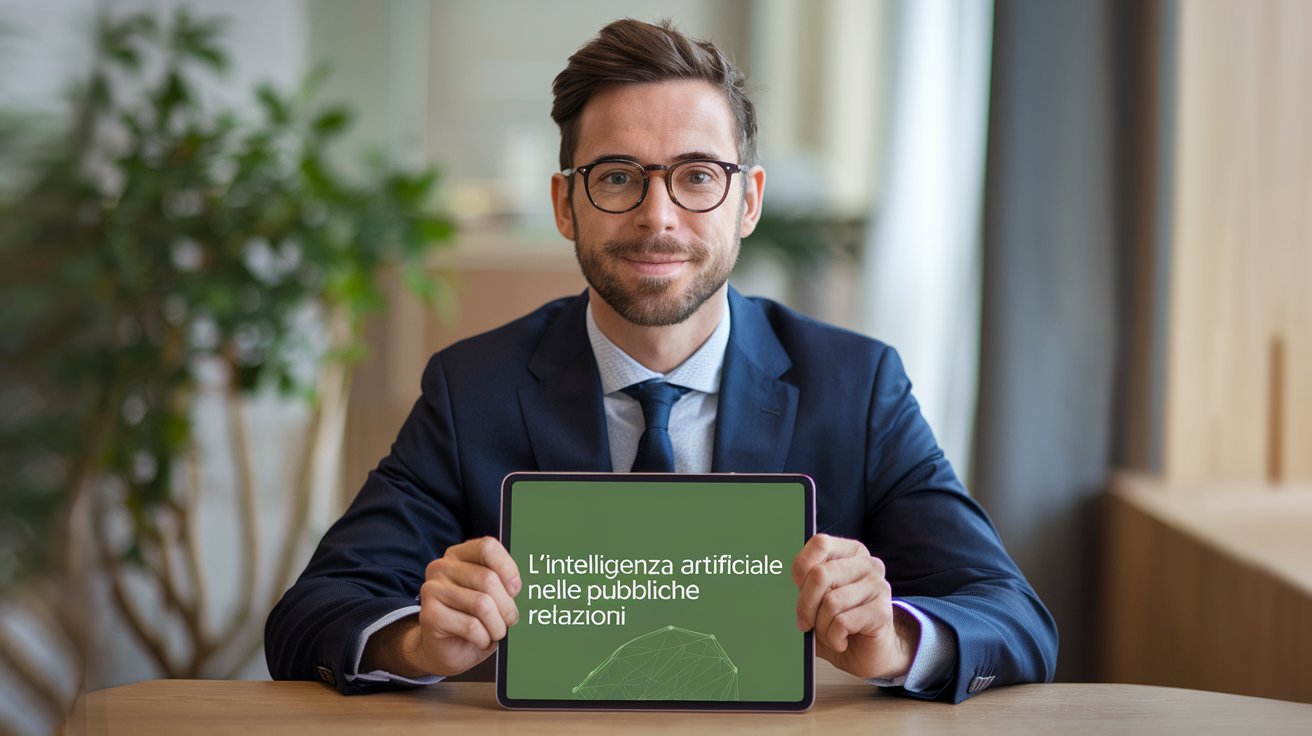
Artificial intelligence is transforming the public relations industry. Discover how to adapt and thrive in this new technological landscape, from emerging opportunities to key challenges.
Artificial intelligence is revolutionizing the public relations sector. Discover how to adapt and thrive in this new technological landscape, from emerging opportunities to challenges to be faced.
Summary
The advent of artificial intelligence (AI) is rapidly transforming the public relations landscape, offering new opportunities and challenges for industry professionals. This technological revolution is redefining traditional roles and creating new professional positions, requiring quick adaptation and an open mind toward innovation. In this article, we will explore how AI is shaping the future of public relations by analyzing the new skills required and the emerging opportunities. We will also examine the ethical and practical challenges that professionals will have to face in this new technological era.
The evolution of the public relations professional’s role
The role of the public relations professional is undergoing a profound transformation thanks to artificial intelligence. What was once a job primarily based on human relationships and creativity now requires a combination of traditional and technological skills.
From communicator to digital conductor
Public relations professionals are increasingly becoming like conductors, coordinating a set of AI-based tools and technologies to optimize their communication strategies. This new role requires:
A thorough understanding of the capabilities and limitations of AI
The ability to integrate AI tools into existing communication strategies
The skill to interpret and act on data generated by AI
The importance of adaptability and continuous learning
In a rapidly evolving industry, adaptability has become a key skill. Public relations professionals must:
Stay constantly updated on the latest innovations in the AI field
Be ready to experiment with new technologies and approaches
Develop a flexible mindset oriented toward continuous learning
The new professional roles in the age of AI
The integration of AI in public relations is giving rise to new specialized professional roles. These new positions require a unique combination of technical and communication skills.
The AI owner
The AI owner is responsible for developing and managing customized AI models for the specific needs of an organization or sector. This role requires:
A deep knowledge of the public relations sector
Technical skills to develop and train AI models
The ability to identify opportunities for applying AI in communication strategies
The model architect
The model architect focuses on improving and optimizing existing AI models to support public relations processes. Responsibilities include:
Analysis and refinement of AI models to improve their performance
Integration of new features into existing models
Collaboration with communication teams to ensure models meet practical needs
The AI agent engineer
The AI agent engineer develops automated systems that can perform specific tasks in public relations. This role requires:
Software development and programming skills
In-depth understanding of public relations processes
Ability to translate communication needs into technological solutions
The AI technician
The AI technician acts as a bridge between AI developers and public relations professionals. Their responsibilities include:
Monitoring and maintenance of AI systems
Training staff on the use of AI tools
Troubleshooting and optimizing system performance
The data trainer
The data trainer plays a crucial role in ensuring that AI models are trained on accurate and unbiased data. This role requires:
Skills in data science and data analysis
In-depth knowledge of ethical issues related to AI
Ability to identify and correct bias in datasets
Artificial Intelligence in PR – ABAI Photo
Practical applications of AI in public relations
Artificial intelligence is finding numerous practical applications in the field of public relations, automating processes and providing valuable insights.
Media monitoring and sentiment analysis
AI is revolutionizing the way public relations professionals monitor and analyze media coverage:
Automated scanning of news articles and social media posts
Real-time sentiment analysis
Identification of emerging trends and potential reputation issues
Prediction and crisis management
AI-powered predictive models are becoming essential tools for crisis management:
Early identification of potential crisis situations
Automated suggestions for response strategies
Scenario simulations to improve crisis preparedness
Content generation and optimization
AI is assisting professionals in content creation and optimization:
Draft generation of press releases and social media posts
Content SEO optimization suggestions
Personalizing messages for different target audiences
Automation of administrative tasks
Many administrative tasks in public relations can be automated thanks to AI:
Creation and updating of media contact lists
Planning and management of editorial calendars
Automatic generation of reports and analysis
Ethical and practical challenges in the use of AI in public relations
The adoption of AI in public relations raises important ethical and practical issues that professionals must address.
Transparency and authenticity
The use of AI in content creation and audience interaction raises issues of transparency:
How to communicate the use of AI in public relations activities?
How to maintain authenticity in AI-assisted communications?
What are the ethical limits in using AI for content creation?
Privacy and data protection
AI requires large amounts of data, raising concerns about privacy:
How to ensure compliance with data protection regulations?
How to balance message personalization with respect for privacy?
What are the ethical responsibilities in data collection and use?
Bias and fairness
AI models can perpetuate or amplify existing biases:
How to identify and mitigate biases in AI models?
How can we ensure that AI is fair and inclusive in its applications?
What are the ethical implications of using AI in communication decisions?
Technological dependence and human skills
The increased use of AI raises concerns about the potential loss of human skills:
How can we balance AI efficiency with the need for human expertise?
Which traditional public relations skills are at risk of being lost?
How can we ensure that AI remains a support tool and not a substitute for human judgment?
Strategies for successfully integrating AI in public relations
To fully leverage the potential of AI, public relations professionals need to take a strategic approach to its integration.
Assessment of needs and opportunities
Before implementing AI solutions, it is essential to:
Identify the areas where AI can bring the most value
Assess the technological maturity of the organization
Set clear objectives for AI adoption
Training and skills development
Investing in staff training is crucial for successful AI integration:
Organize workshops and training courses on AI
Encourage continuous learning and skills upgrading
Create interdisciplinary teams that combine communication and technology experts
Gradual implementation and testing
A gradual approach to adopting AI can help manage risks and optimize results:
Start with pilot projects in specific areas
Carefully monitor results and collect feedback
Continuously iterate and improve AI solutions
Collaboration with AI experts
Collaborating with AI experts can accelerate adoption and enhance effectiveness:
Establish partnerships with technology companies specializing in AI
Hire or consult AI experts to guide the implementation
Participate in communities and forums dedicated to AI in public relations
Artificial Intelligence in PR – ABAI Photo
The future of public relations in the era of AI
Looking ahead, AI will continue to transform the public relations sector in significant ways.
Advanced personalization
AI will enable increasingly sophisticated personalization of communications:
Tailored messages based on real-time behavioral analysis
Predicting audience preferences and reactions
Creating highly interactive and personalized communication experiences
Integration with other emerging technologies
AI will integrate with other emerging technologies to create new possibilities:
Augmented and virtual reality for immersive storytelling experiences
Internet of Things to collect real-time data and improve audience understanding
Blockchain to ensure transparency and authenticity in communications
Evolution of professional roles
Roles in the public relations sector will continue to evolve:
Greater emphasis on data analysis skills and AI management
Emergence of new specializations related to AI ethics and data governance
Growing importance of soft skills such as creativity, empathy, and critical thinking
Ethical and regulatory challenges
The increasing use of AI will raise new ethical and regulatory challenges:
Need for specific ethical guidelines for the use of AI in public relations
Potential regulation of AI use in public communication
Ongoing debate on balancing technological innovation and human values
Conclusion: embracing change with awareness
Artificial intelligence is redefining the landscape of public relations, offering unprecedented opportunities but also significant challenges. To thrive in this new era, professionals must embrace change with an open and critical mindset.
It is essential to stay up to date with the latest innovations, develop new skills, and adapt to emerging roles. At the same time, it is crucial to maintain a strong ethical sense and a deep understanding of the value of human relationships in our sector.
AI will not replace public relations professionals, but will expand their capabilities. The future belongs to those who can skillfully integrate artificial intelligence with unique human skills, creating communication strategies that are more effective, personalized, and impactful than ever before.
Navigating this new frontier will require courage, creativity, and a constant commitment to learning. But for those who accept the challenge, the possibilities are endless. The future of public relations is here, and it is exciting, complex, and full of opportunity. It is up to us to shape it in the right way.
Usiamo cookie per ottimizzare il nostro sito web ed i nostri servizi.
Funzionale
Always active
L'archiviazione tecnica o l'accesso sono strettamente necessari al fine legittimo di consentire l'uso di un servizio specifico esplicitamente richiesto dall'abbonato o dall'utente, o al solo scopo di effettuare la trasmissione di una comunicazione su una rete di comunicazione elettronica.
Preferenze
L'archiviazione tecnica o l'accesso sono necessari per lo scopo legittimo di memorizzare le preferenze che non sono richieste dall'abbonato o dall'utente.
Statistiche
L'archiviazione tecnica o l'accesso che viene utilizzato esclusivamente per scopi statistici.L'archiviazione tecnica o l'accesso che viene utilizzato esclusivamente per scopi statistici anonimi. Senza un mandato di comparizione, una conformità volontaria da parte del vostro Fornitore di Servizi Internet, o ulteriori registrazioni da parte di terzi, le informazioni memorizzate o recuperate per questo scopo da sole non possono di solito essere utilizzate per l'identificazione.
Marketing
L'archiviazione tecnica o l'accesso sono necessari per creare profili di utenti per inviare pubblicità, o per tracciare l'utente su un sito web o su diversi siti web per scopi di marketing simili.