Home » Blog » Digital Travel » Speed and Relevance: How PR and Artificial Intelligence Help You Ride the Wave of Trends
Speed and Relevance: How PR and Artificial Intelligence Help You Ride the Wave of Trends
Artificial intelligence is transforming reactive PR strategies, enabling brands to respond faster to emerging trends. Here’s how to leverage these new tools to maximize your media visibility.
In the dynamic landscape of digital communication, the ability to respond quickly to emerging trends has become fundamental for the success of public relations strategies. The advent of artificial intelligence has opened new frontiers in this field, offering powerful tools to analyze data, generate insights, and personalize communications at record speed. This technological revolution is redefining the way PR professionals approach their work, enabling unprecedented responsiveness to trending topics.
Summary
The goal of this article is to explore how artificial intelligence is transforming the reactive PR sector, providing concrete strategies and practical advice to make the most of these new technologies. We will analyze how AI can enhance human creativity, accelerate decision-making processes, and improve the effectiveness of communication campaigns. We will also look at how to integrate these innovative tools into existing workflows, balancing automation and the human touch to achieve optimal results.
Whether you are a veteran PR professional or new to the industry, this article will provide you with the tools you need to stay competitive in the era of artificial intelligence applied to public relations. Get ready to discover how to capitalize faster and more effectively on trending topics, leveraging all the potential of AI to make your brand shine in today’s media landscape.
The AI Revolution in Reactive PR
Artificial intelligence is radically transforming the public relations sector, especially in the field of reactive PR. This technological innovation offers industry professionals powerful tools to rapidly analyze large amounts of data, identify emerging trends, and react in real time to developments in the media landscape.
The integration of AI into public relations has led to a profound transformation in how companies manage their online reputation. Technological innovations have completely revolutionized the approach to corporate communication, introducing new methodologies and tools that have made PR activities more effective and measurable.
AI Capabilities in PR
Constantly monitor public sentiment: AI algorithms are able to analyze millions of online conversations, quickly identifying changes in sentiment towards the brand, products, or services. This enables prompt intervention in the event of a crisis or to seize emerging opportunities. Real-time analysis also makes it possible to identify behavioral patterns and consumer preferences that might escape the human eye.
Predict crises: using advanced predictive models, AI can identify early warning signs of a potential crisis, allowing companies to take preventive measures and mitigate damages. These models constantly analyze variables such as the volume of negative mentions, the speed at which news spreads, and the engagement of key stakeholders.
Personalize communications: AI allows for the creation of highly personalized messages tailored to the needs and interests of specific audience segments. This increases the effectiveness of communications and strengthens engagement. Personalization also extends to choosing the most appropriate channels, timings, and delivery methods for each recipient.
Automate repetitive processes: activities such as media monitoring, report generation, and social media management can be automated, freeing up time for PR professionals to focus on more strategic and creative tasks. Automation also reduces the risk of human error and ensures greater consistency in communication.
Improve outcome measurement: thanks to AI, it is possible to precisely measure the impact of PR campaigns, identifying key metrics and attributing results to different initiatives. Advanced analytics tools allow for tracking the complete customer journey and assessing the ROI of communication activities.
Concrete Application Examples
Content Generation: AI tools can generate drafts of press releases, social media posts, and other content, adapting them to different channels and audiences. For example, a company could use AI to create personalized content for specific influencers, increasing the chances of collaboration. The technology can also suggest SEO optimizations and the appropriate tone of voice for different contexts.
Chatbots and virtual assistants: chatbots can interact with customers in real time, providing answers to frequently asked questions and solving common problems. This not only improves the customer experience, but also frees up time for customer service representatives. The most advanced chatbots are able to learn from previous interactions and constantly improve their performance.
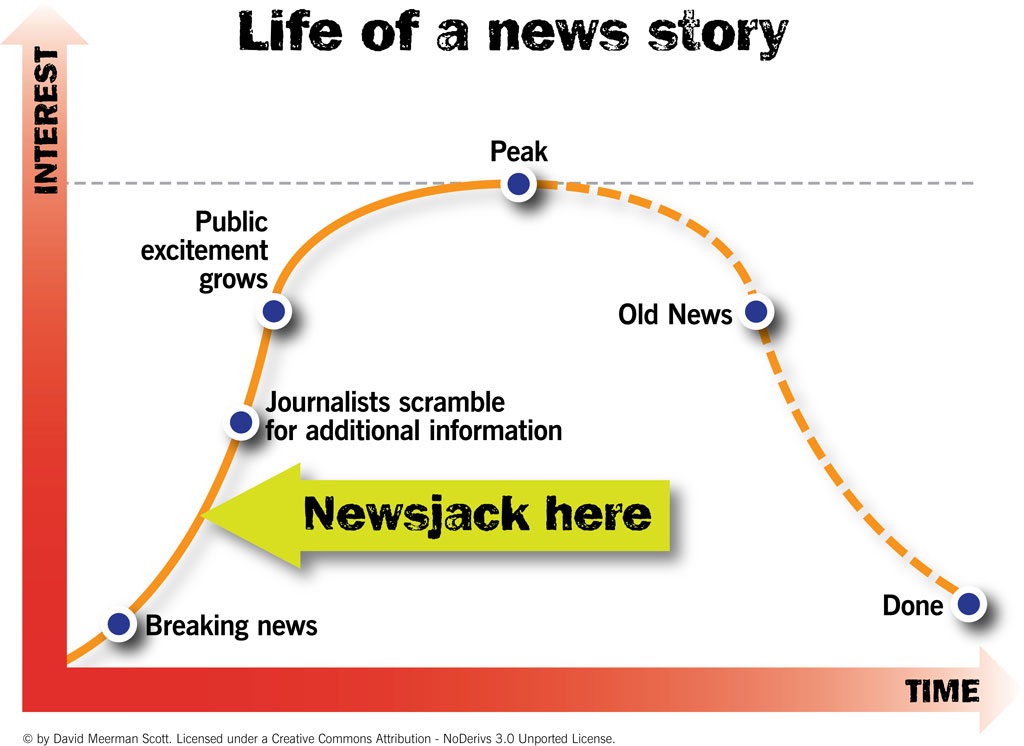
Trend analysis: AI can identify emerging trends in the sector and suggest newsjacking opportunities. For example, a company could use AI to identify relevant current events or topics in its sector and create content that leverages these opportunities to increase brand visibility. Predictive analysis can also help anticipate future market trends.
Newsjacking – Photo David Meet Scott
Influencer monitoring: AI can identify the most relevant influencers for a brand and measure their impact on online conversations. This enables building more effective relationships with influencers and maximizing return on investment. Algorithms can also predict the potential success of future collaborations based on historical data.
Challenges and opportunities
Despite the numerous advantages, the use of AI in reactive PR also presents some significant challenges that must be carefully considered:
Algorithmic bias: AI algorithms can reflect the biases present in the data on which they are trained. It is essential to monitor and mitigate these biases to ensure fairness and transparency. For example, an AI algorithm might favor certain demographic groups or viewpoints, leading to a distorted representation of reality.
Privacy: the collection and analysis of large amounts of personal data raise important privacy concerns. It is necessary to comply with current regulations and ensure the protection of users’ data. For instance, it is essential to obtain users’ consent before collecting and using their data for marketing purposes.
Dependence on technology: excessive reliance on AI can limit the critical and creative thinking abilities of PR professionals. It is important to maintain a balance between the use of AI and human contribution, valuing the unique skills of both.
Future discussions
The impact of AI on the role of PR professionals: how will the skills required of PR professionals change in the age of AI? What new professional figures will emerge? How will the relationship between humans and machines evolve in the PR sector?
Ethics in the use of AI in communications: what are the ethical principles that should guide the use of AI in PR? How can transparency and accountability be ensured? What role do company values play in the implementation of AI?
Best practices for implementing AI in PR: what steps should be followed to successfully implement AI in an organization? How to manage the necessary cultural change? What skills should be developed internally?
The future of AI in PR: what are the next frontiers? Which emerging technologies will have a significant impact on PR? How will the relationship between traditional and digital communication evolve?
Conclusions
Artificial intelligence is revolutionizing the way companies manage reactive public relations. By offering powerful tools to analyze data, automate processes, and personalize communication, AI enables companies to enhance their online reputation and strengthen relationships with customers. However, a balanced and mindful approach is essential, one that considers both the challenges and opportunities of this technology. The ongoing evolution of AI promises to bring further innovation to the field of PR, opening up new possibilities for corporate communication management. Organizations that can effectively integrate these technologies into their processes, while maintaining an ethical and human-centered approach, will be better positioned to face the communication challenges of the future.
Usiamo cookie per ottimizzare il nostro sito web ed i nostri servizi.
Funzionale
Always active
L'archiviazione tecnica o l'accesso sono strettamente necessari al fine legittimo di consentire l'uso di un servizio specifico esplicitamente richiesto dall'abbonato o dall'utente, o al solo scopo di effettuare la trasmissione di una comunicazione su una rete di comunicazione elettronica.
Preferenze
L'archiviazione tecnica o l'accesso sono necessari per lo scopo legittimo di memorizzare le preferenze che non sono richieste dall'abbonato o dall'utente.
Statistiche
L'archiviazione tecnica o l'accesso che viene utilizzato esclusivamente per scopi statistici.L'archiviazione tecnica o l'accesso che viene utilizzato esclusivamente per scopi statistici anonimi. Senza un mandato di comparizione, una conformità volontaria da parte del vostro Fornitore di Servizi Internet, o ulteriori registrazioni da parte di terzi, le informazioni memorizzate o recuperate per questo scopo da sole non possono di solito essere utilizzate per l'identificazione.
Marketing
L'archiviazione tecnica o l'accesso sono necessari per creare profili di utenti per inviare pubblicità, o per tracciare l'utente su un sito web o su diversi siti web per scopi di marketing simili.