When you think about content optimization, your top priority should be search intent. Think about how many times you’ve typed something into Google that was practically incomprehensible, and it understood exactly what you meant. This is something we may take for granted, but it is exactly why search intent is so important.
Summary
Monthly search volume is nice to have, but since it’s impossible to create demand, we need to align our high-quality content and product landing pages with the customer’s intent.
Google has never really cared that we optimize our content. It cares about providing the user with the most relevant and unique content to help them find what they are looking for. Google updates its algorithm so often because it wants to ensure it meets the hearts, minds, and souls of its users, and matches their queries with relevant results.
In this article, we’ll look at why search intent is the most important thing to consider when optimizing content, and how to build a content strategy based on search intent research.
What is search intent?
The search intent, also known as customer intent e or user intent, is the main reason why users access a search engine and type in a query.
When someone visits a search engine, they have a specific goal in mind that they’re trying to achieve with their search. Think about all the times you’ve used a search engine to research a product or to get an answer to a question. And with the rise of mobile search, we now always have a search engine in our pockets.
That’s why, as marketers and SEOs, we need to understand where our customers are in the buyer’s journey when they type in a specific phrase, and which content or landing page we should target for that phrase. Search intent is truly the backbone of a well-optimized landing page and should be our main goal when creating content on our site. However, we must keep in mind the different stages of a customer’s search journey.
What are the different types of search intent?
There have been many times when I’ve searched Google without even knowing what I was looking for. Other times, I’ve used it for spell checking or to remind myself of the name of a particular movie. For the most part, we can group search intent into three main categories.
Learn how you can plan and create content to satisfy the following 3 types of search intent.
1. Informational
These are early-stage search queries where the customer is still trying to learn more about the topic. When a user is in the early stages of research, our goal is to make sure the user learns more about the product or service.
Studies show that if a user learns something from a website and that site establishes itself as an authoritative source on the topic, that user will end up returning to the website and converting later, when they’re ready.
Informational Content
2. Comparative (also known as navigational)
This is mid-funnel content where the customer is trying to compare your product or service with another to help them decide what to do. Users in the intermediate or comparative stage are trying to see if they really need the product or service they were looking for, or if there are even better options than what they previously found. Think about all the times you’ve compared different restaurants to each other, or two similar products.
Comparative Content
3. Transactional
These are late-stage content where the customer is ready to convert. The reason we created all the other content is to make sure we support our users and help them along the journey, so they can convert.
Our transactional or bottom-funnel content is typically category or product pages where we want the user to land when they’re ready to purchase.
Transactional Content
By creating content and landing pages that match all parts of a user’s journey, we can make sure we’re targeting the right keywords on the best page Google wants to show.
We can also ensure we own our digital presence and increase visibility and conversions.
While half the battle is making sure our content is properly optimized, the other half is making sure Google even wants to show our content for the phrase, which is why search intent is so important.
What makes search intent so important?
There are thousands of different factors to consider in keyword research, such as search volume, seasonality, branded or not, localization, etc. But search intent, or user intent, is the most important.
Understanding the searcher’s intent ensures we are prioritizing relevance in our content and keywords. The more phrases a user types into Google or another search engine, the further they are in the buyer’s journey and the higher the chances of conversion.
Search intent is also extremely difficult to understand. But once you understand search intent, optimizing content is much easier, since you’ll know more about the type of content Google wants to display on the first page.
The main thing we should consider is that we aren’t deciding what search intent is—Google is. If you go against what Google says, your content will not appear in the SERP. There are also many cases where marketers or executives get blinded by search volume. Instead of chasing lower volume phrases that have a better chance of winning, they pursue the higher volume phrases and end up missing the mark.
How can we make sure our content matches search intent?
When you’re trying to understand the concept of search intent, take a step back from your business and imagine you’re a user.
Think about what you might search to get to your blog article or product page. Type that phrase into Google (preferably using incognito or private browsing, so it’s not personalized based on your search history) and see what comes up.
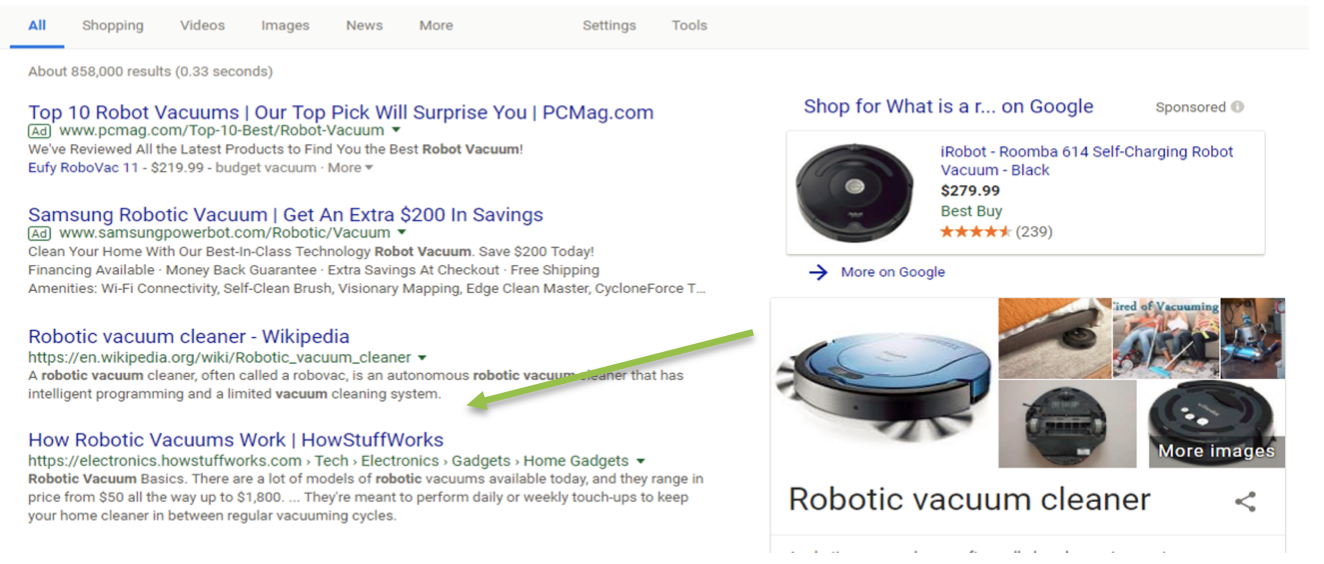
A SERP analysis (search engine results page) is the best way to confirm what Google thinks the user might want to see.
Are there content aggregators? Are there transactional sites?
Is there a mixed search engine results page with both content and transactional content?
There are many times when even Google doesn’t know what the user is searching for, so it shows a mixed SERP with different types of content.
By finding this information live on the SERPs, we can see what Google rewards in top positions and what it believes is the intent behind the user’s query.
SERP analysis is one of the best ways to use competitor data when creating content, because we want to know what phrases they are using and see if we can even compete for that same phrase based on intent.
How can we create a content strategy for search intent?
Content might be king, but the user holds all the power. We can create the best content in the world, but if the keywords we target don’t match the user’s intent, it’s really all for nothing.
Bringing in unqualified traffic doesn’t help anyone and is a waste of time and energy. We need to make sure to do our keyword and competitor research before creating our content. By understanding who else is competing in the SERP, we now know if we have a chance to rank on page one.
Competitive research also allows us to find semantically related keywords we might want to use in the content. These are keywords that aren’t necessarily synonyms but are closely related in nature. Semantically related keywords give search engines a better understanding of what our content is about and also allow users searching for similar things (but using different keywords) to find our content.
One of the best ways to build a content strategy with search intent in mind is the hub and spoke content marketing model. This content marketing model lets us target our transactional keywords on the hub pages and more informational keywords on the spoke pages.
This way, we can ensure we have content that matches where our users might be and the different stages of their journey. Keyword research is the bread and butter of a content strategy and is extremely important for understanding search intent.
Keywords with the highest search volume may be attractive, but they can also be very vague and might not be the best words to focus on.
There are also many times when some keywords—singular or plural—have a different meaning. For example: if you search for [TV] you might be looking for a guide to TV channels or the history of television.
However, if you search for [TVs], you’re probably looking to buy a television somewhere and will see the corresponding search results. The point is: SEO professionals must constantly look at what’s already on Google and adopt the user’s or customer’s perspective during research.
This image helps us better understand the content strategy we might follow if we’re selling reading glasses.
We should target the highest volume keywords on our home pages or category pages. Lower volume keywords could then be targeted on subcategories, product pages, and maybe a blog article.
By creating a visual like this, we can identify the total number of keywords we’re trying to track, which can help us understand how much content or what kind of content we need to create.
Conclusion
Putting our customers first and identifying the search intent behind their query is the best way to ensure our content meets our customers’ needs. We’ve also only discussed half the story so far: the search side.
The exciting part comes when you are able to use an enterprise SEO platform to track keyword rankings and report to executives on the changes made and how they resulted in a significant increase in traffic or conversions. By frequently monitoring and reporting our wins, we can gain more buy-in for our SEO program and evangelize why SEO is important to our organization, making it easier to have a seat at the table for more significant decisions.
Search intent will always be the most important factor when it comes to keyword research and optimizing our content. Recent Google algorithm updates have focused heavily on user experience, but continue to place greater emphasis on user intent and making its search engine more conversational in order to deliver the most accurate search results for users.
So, when in doubt, make sure that search intent and keyword relevance are your main areas of focus when creating and updating content.
Usiamo cookie per ottimizzare il nostro sito web ed i nostri servizi.
Funzionale
Always active
L'archiviazione tecnica o l'accesso sono strettamente necessari al fine legittimo di consentire l'uso di un servizio specifico esplicitamente richiesto dall'abbonato o dall'utente, o al solo scopo di effettuare la trasmissione di una comunicazione su una rete di comunicazione elettronica.
Preferenze
L'archiviazione tecnica o l'accesso sono necessari per lo scopo legittimo di memorizzare le preferenze che non sono richieste dall'abbonato o dall'utente.
Statistiche
L'archiviazione tecnica o l'accesso che viene utilizzato esclusivamente per scopi statistici.L'archiviazione tecnica o l'accesso che viene utilizzato esclusivamente per scopi statistici anonimi. Senza un mandato di comparizione, una conformità volontaria da parte del vostro Fornitore di Servizi Internet, o ulteriori registrazioni da parte di terzi, le informazioni memorizzate o recuperate per questo scopo da sole non possono di solito essere utilizzate per l'identificazione.
Marketing
L'archiviazione tecnica o l'accesso sono necessari per creare profili di utenti per inviare pubblicità, o per tracciare l'utente su un sito web o su diversi siti web per scopi di marketing simili.