Home » Blog » Digital Travel » The real issue isn’t social media itself, but how it’s managed: why “digital flyers” are driving clients away from travel agencies
Home » Blog » Digital Travel » The real issue isn’t social media itself, but how it’s managed: why “digital flyers” are driving clients away from travel agencies
The real issue isn’t social media itself, but how it’s managed: why “digital flyers” are driving clients away from travel agencies
Social media aren’t the problem—the issue is how they’re used. If a travel agency only shares digital flyers, that’s not marketing; it’s just filling empty space.
In recent years, I have often heard the same phrase:“We started an Instagram, but it doesn’t bring in clients” Or:“TikTok is just for young people, it doesn’t work for selling trips” And again:“The website is useless, everyone looks at social media anyway”.
Summary
The truth is something else: social media and websites absolutely do work, even in tourism. But they don’t work if they’re managed poorly. The problem isn’t the tools, but who manages them. Too many travel agencies (and too many “pseudo social media managers”) treat digital as a simple copy of what they do offline. Result? Online showcases that don’t build trust, don’t attract new clients, and end up losing even those who might be interested.
The wrong model: the online flyer
Imagine a classic travel agency. In the shop window, colorful posters with offers for the seaside, organized tours, New Year’s Eve packages. Prices highlighted, dates and contact details.
Does it work? Yes, if the goal is to attract people walking past the agency.
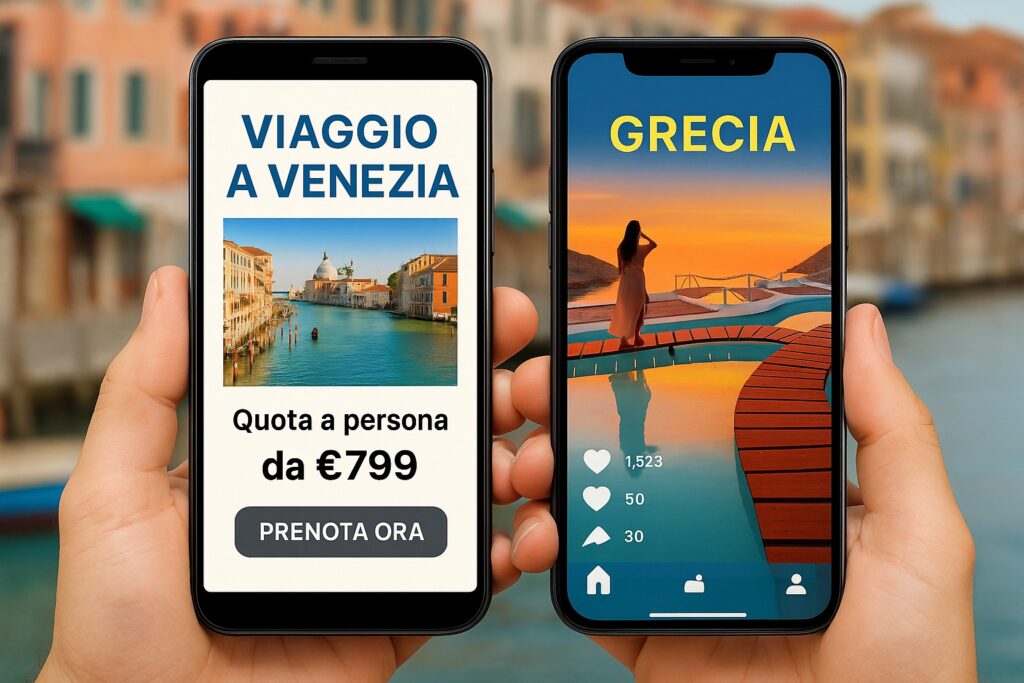
Now let’s move the same model onto social media: posts with graphics full of writing, packages starting from €599, countdowns for limited spots. Or websites full of pages with standard offers and price lists.
Does it work? No. On Instagram or TikTok, users don’t log in to browse catalogs. On Google, they aren’t searching for “7-night Maldives tour package,” but for questions like “when to go to the Maldives,” “what to see in Malé,” “which atolls to choose.”
That’s why digital flyers don’t work. They don’t capture the user’s intention, don’t create desire, don’t build trust.
Why this approach makes you lose clients
Social media are platforms for entertainment and discovery, not shelves of special offers. Websites are hubs of content, not noticeboards full of price lists. If a travel agency only posts flyers online, it communicates three implicit messages:
They have no stories or content to share → so they have no added value.
It’s all about the price → and when it comes to price, someone else always wins.
They don’t know the rules of digital → so they appear less professional.
Today’s client is far more informed than before. If they’re looking for inspiration, they go to Instagram or TikTok. If they want practical answers, they go to Google. If they just find digital flyers, they scroll past and look elsewhere. The damage isn’t just “not selling”: the real harm is burning your credibility. And in tourism, trust is the most valuable currency.
The false myth of the “social media manager”
Often agencies turn to a “social media manager” thinking it will solve the problem. But just having someone post is not enough if the content is wrong. An unskilled social media manager who only creates graphics with prices isn’t developing a strategy—they’re just putting the flyer online. It’s like having a designer who changes the posters in your shop window every week.
What’s the result?
A monotonous feed, with no storytelling.
No organic growth.
No brand positioning.
A true digital marketing professional doesn’t just fill spaces: they build content, positioning, and relationship strategies.
What a travel agency really needs
To stand out online, an agency shouldn’t just “be there”, it should be there properly. Here’s what makes the difference:
Emotional storytelling → telling stories about experiences, not just selling packages.
Evergreen content → practical guides, features, and tips that remain relevant over time.
Serial formats → recognizable recurring features that build anticipation and loyalty.
SEO and AEO → websites optimized for Google and conversational engines, capturing real questions.
Cross-channel consistency → website and socials speaking the same language.
Concrete examples: what not to do and what to do
What not to do: posting the offer “7 nights in Sharm for €899” on Instagram. What to do: reels like “3 unmissable experiences in Sharm” + article “What to see in Sharm el-Sheikh” on the website.
What not to do: filling the website with 50 copy-paste packages from tour operators. What to do: original guides enriched with genuine tips, videos, and FAQs.
What not to do: only using stock graphics with logos and prices. What to do: alternate emotional images, testimonials, and behind-the-scenes content.
The value of professionalism
An improvised website or social profile is not just useless: it’s harmful. It communicates a lack of seriousness, lowers the perception of the brand, and makes people think the agency is not up to date. A website or social profile managed by professionals, on the other hand:
positions the agency as authoritative;
sets it apart from competitors;
builds trust even before direct contact.
My experience
In my work, I often encounter two types of situations:
those who stopped at the digital flyer model and struggle to attract clients;
and those who invested in a digital strategy and are now reaping results in terms of visibility and inquiries.
It’s not a matter of luck, but of method. And method is built with skills, experience, and a long-term vision.
Conclusion: stop wasting time with online flyers
The problem isn’t social media, the website, or digital itself. The problem is how you use them. If you turn your social channels into a showcase of offers, not only will you not sell, but you will lose credibility. If you create valuable content with the help of professionals, social media and your website become your most powerful channels.
If you are a travel agency and you really want to make the leap, book a free consultation with me. Because social media isn’t for showing prices: it’s for building trust, desire, and clients.
FAQ
Why don’t travel agencies’ social media work?
Because they are often used as showcases for offers, instead of as tools for inspiration and building relationships with travelers.
Is it worth posting offers on social media?
Not on their own: an offer without emotional context doesn’t generate interest. It’s better to accompany it with storytelling, guides, and valuable content.
What should a travel agency’s website be like?
An effective website should offer guides, tips, and useful content, not just copy-and-paste packages from tour operators.
Is a social media manager enough to make an agency grow?
Only if they work strategically. Simply creating digital flyers isn’t marketing; it’s just filling space.
Usiamo cookie per ottimizzare il nostro sito web ed i nostri servizi.
Funzionale
Always active
L'archiviazione tecnica o l'accesso sono strettamente necessari al fine legittimo di consentire l'uso di un servizio specifico esplicitamente richiesto dall'abbonato o dall'utente, o al solo scopo di effettuare la trasmissione di una comunicazione su una rete di comunicazione elettronica.
Preferenze
L'archiviazione tecnica o l'accesso sono necessari per lo scopo legittimo di memorizzare le preferenze che non sono richieste dall'abbonato o dall'utente.
Statistiche
L'archiviazione tecnica o l'accesso che viene utilizzato esclusivamente per scopi statistici.L'archiviazione tecnica o l'accesso che viene utilizzato esclusivamente per scopi statistici anonimi. Senza un mandato di comparizione, una conformità volontaria da parte del vostro Fornitore di Servizi Internet, o ulteriori registrazioni da parte di terzi, le informazioni memorizzate o recuperate per questo scopo da sole non possono di solito essere utilizzate per l'identificazione.
Marketing
L'archiviazione tecnica o l'accesso sono necessari per creare profili di utenti per inviare pubblicità, o per tracciare l'utente su un sito web o su diversi siti web per scopi di marketing simili.