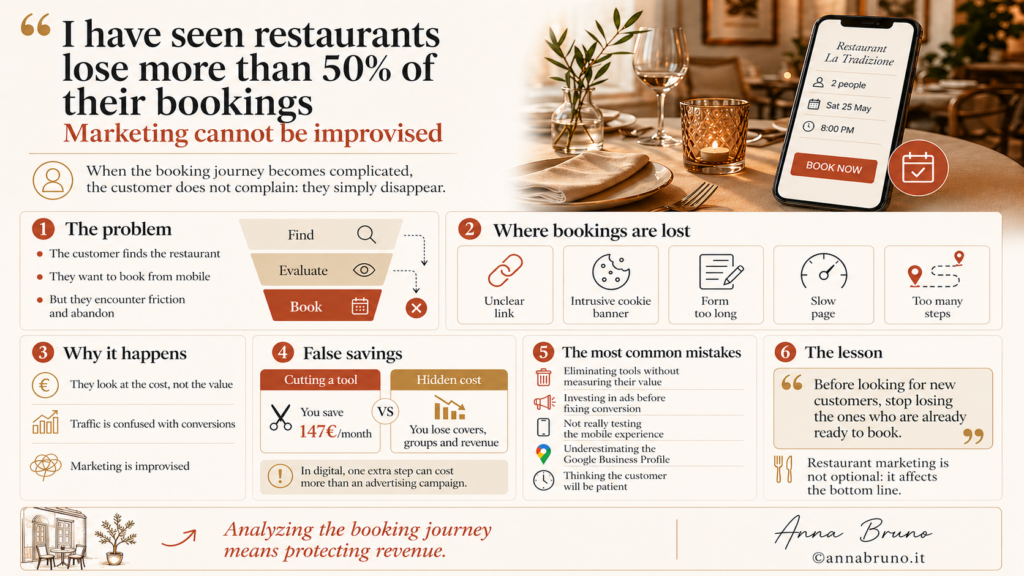
I’ve seen restaurants lose over 50% of their reservations: marketing can’t be improvised.
Many restaurants lose bookings not because there’s a lack of customers, but because they make it difficult for those who are already ready to reserve a table. In restaurant marketing, every digital decision matters: removing a tool, using a slow form, or making choices without data can easily turn into lost covers and missed revenue.
In restaurant marketing, the problem is not always finding new customers. Sometimes the issue is losing those who were already ready to book. I’ve seen restaurants with traffic, visibility, and real demand compromise their booking system due to decisions made without analyzing the numbers.
Summary
I’ve seen restaurants lose more than 50% of reservations
This isn’t just a catchy phrase. It’s something I’ve truly seen happen. And in some cases, the loss can be even greater than 50%, especially when the removed channel was the closest to the decision moment. The point is that many businesses don’t lose reservations because they lack visibility. They lose them because they complicate the process for those who had already decided, or almost decided, to book.
A restaurant can have a good Google listing, positive reviews, nice photos, an appealing location, mobile traffic, and a recognizable name. But if, at the crucial moment, the user doesn’t immediately see the easiest way to book, a large portion of that value is wasted. This is exactly where marketing is often misunderstood. Many reduce it to advertising, social media, posts, reels, and sponsored ads. But marketing, in a restaurant, is also and above all about how you turn interest into a booking.
You don’t lose a customer when they can’t find you, but when they can’t act
This is one of the most uncomfortable truths in digital. We’re used to thinking that the big problem is being found: ranking on Google, appearing on maps, being visible on social media, getting reviews, making content. All true. But not enough. Because a customer can find you, look at you, choose you mentally, and still leave.
It happens when the process is too long. It happens when the button isn’t clear. It happens when the booking link is hidden or hard to spot. It happens when a user lands on a slow page, has to close a cookie banner, scroll, figure out where to click, fill out a clunky form and wait for a confirmation.
On mobile, all this matters even more. The user isn’t sitting calmly in front of a computer, ready to study the restaurant’s site. Often, they’re deciding in just a few seconds, comparing several places, maybe while out and about, as a car passenger, on a work break, or organizing a night out with others. In that moment, they don’t want to be educated about your system.They want to book.
A link isn’t the same as a booking button
One of the most serious mistakes I see is thinking that a link on the website can replace an immediate booking system. Technically, it might seem true: the user clicks, lands on the page, fills out the form, submits. But in reality, in terms of digital behavior, it’s not the same thing. It’s one thing to have a visible, immediate booking button, integrated where the user is already deciding. It’s quite another to send them to an external page, with an embedded form, possibly inside an iframe, preceded by cookie banners, text, menus, graphics, and extra steps. The difference isn’t about aesthetics. It’s about money.
Every extra step lowers the likelihood that the user will complete the action. Every bit of friction causes abandonment. Every second of uncertainty is another chance for the person to go back and pick another restaurant.In marketing this is called conversion. In the financial statement it’s called lost covers.
Why tools like Reserve with Google are so powerful
When a booking system is integrated directly into Google, especially in Maps and business listings, it captures the user at the hottest moment of the journey. The person isn’t in some generic phase of inspiration. They’re looking for a place to go, comparing alternatives, reading reviews, viewing photos, making a decision.
If at that moment they find a clear button to book, the process becomes almost natural:
search for a restaurant;
find the Google Business profile;
look at photos, hours, and reviews;
click on book;
confirm in a few steps.
This is a nearly perfect funnel because it reduces the gap between intention and action. It doesn’t ask the user to switch environments, doesn’t force them to interpret a website, doesn’t impose a long journey. It allows them to immediately do what they were already inclined to do. That’s why removing such a system without replacing it with an equivalent alternative isn’t just a technical choice. It’s a structural modification to the sales process.
The false economy: cutting €147 and losing revenue
Many mistakes stem from a superficial look at costs. You see the monthly fee for a piece of software and think: “we can save this.” It sounds prudent, even sensible. But the fundamental question is missing: How much revenue does that software generate or protect?
If a system costs €147 a month but allows you to receive direct, continuous bookings throughout the day—often from customers already ready to choose—then that cost isn’t just any expense. It’s part of the restaurant’s commercial engine. Just a few lost bookings are enough to turn that saving into a loss. If those bookings are for tables of four, six, eight people, then the loss is no longer symbolic. It becomes concrete, measurable, significant.
The problem is that the software cost is immediately visible. The lost reservation is not. You don’t get a notification saying: “this person would have booked, but abandoned.” The lost customer doesn’t explain. Doesn’t complain. Doesn’t warn. They simply disappear.
Lost reservations are invisible, but not any less real because of it
This is one of digital marketing’s biggest challenges. Some data is visible, and some requires interpretation. Traffic is visible. Clicks are visible. Confirmed bookings are visible. But abandonment is often hidden. A user who opens the Google listing, looks for the booking button, doesn’t immediately find it, clicks to the website, gets lost on the page and abandons, doesn’t always leave a clear trace. Yet that was a potential customer.
That’s why a marketer’s job isn’t just to look at numbers but to understand their meaning. A good marketer should ask themselves:
where do the best bookings come from;
which channel captures the strongest intent;
how many steps does it take to book on mobile;
where users might abandon;
how much a tool is really worth in the conversion pathway;
what’s the difference between traffic, clicks, and real bookings.
Without this analysis, decisions are made blindly. And when you decide blindly in digital, the bill almost always comes due later.
The paradox: cutting the hot channel and paying for cold traffic
There is another paradox I often see in restaurants: they get rid of tools that capture warm demand, and at the same time, they keep spending on advertising through channels where the user’s intention is much lower. I’m not saying that Facebook Ads or Instagram Ads are useless. They can be effective if used in the right strategy. But they shouldn’t be confused with Google Maps or local search.
A person looking for a restaurant on Google Maps is already making a decision. Someone who sees a sponsored post on Facebook is doing something else: they scroll, watch, get distracted, maybe get a little curious. These are two completely different moments. The first is a warm user. The second, in most cases, is a cold or lukewarm user.
Driving cold traffic to a slow or complicated booking page only makes the problem worse. It’s like filling up a leaky bucket: you can pour in more water, but it will keep leaking out. Before increasing traffic, you need to seal the leaks. Before investing in ads, you need to verify that the booking process converts. Before asking the market for new customers, you have to stop losing the ones that already arrived.
Marketing is not about making posts, it’s about reading people’s behavior
Here comes the most important point. Marketing isn’t a series of decorative activities. It’s not about posting something on social media, making a graphic, launching a promotion, changing a cover photo or writing a catchy tagline. Marketing, especially in the restaurant business, means understanding human behavior as applied to numbers.
It means understanding why someone chooses one venue over another. It means knowing how much a review matters, how important the button placement is, how much the site’s speed impacts, how a form that’s too long can harm conversions, and how conversion rates change if a user has to complete three steps instead of one.
It also means having the courage to tell a client: this choice is wrong. Not because of personal taste, but because the funnel, mobile behavior, data, and experience say so.
A skilled restaurant owner doesn’t become a marketer after one course
I say this with respect, but also with great clarity: marketing is not something you can improvise. Just as you can’t improvise in the kitchen, in the dining room, with staff management, food cost control, relationships with suppliers, or building a sustainable menu.A restaurant owner can be extremely skilled in their field and still lack the expertise to properly evaluate a digital funnel. There’s nothing wrong with that. The problem arises when they think they can do it anyway, just because they’ve taken a few courses, read a few guides, or learned how to use some tools.
Using a tool doesn’t mean knowing how to make strategic decisions. Everyone uses social media, but not everyone can do marketing. Everyone searches on Google, but not everyone understands the value of local search. Anyone can open an ad panel, but not everyone knows how to calculate the real cost of a booking.
In the kitchen, nobody would think that watching a few videos is enough to lead a kitchen team. In marketing, however, this presumption is still very common. And it’s dangerous, because bad decisions don’t always cause immediately visible harm. Sometimes they work quietly, day by day, draining the flow of reservations.
Digital presumption is one of the hidden costs of the restaurant business
Many restaurant owners are rightly proud of their business. They’ve invested money, time, energy, effort. They know their venue, their regulars, their area, their day-to-day problems. But this very familiarity can become a limitation when it comes to digital experience. The owner already knows where to click. They know there’s a booking page. They know how the form works. They know the proprietary system is connected to the server. They know that, somehow, the booking arrives. The customer does not.
The customer only sees what appears in that moment, on their phone, in just a few seconds. If it’s not clear, they won’t wait. If they don’t understand, they won’t investigate. If they find friction, they move on. This difference between the internal point of view and the user’s point of view is huge. And it’s exactly why you need an external professional, someone who can look at the process without bias, without habit, without excuses.
The most common mistakes that cause lost bookings
Over time, I’ve seen certain mistakes repeat themselves at an impressive rate. They don’t just affect small restaurants, but also established businesses, groups, venues with a good reputation, and entrepreneurs convinced they have everything under control.
eliminating tools without measuring the value they generate: focusing on the cost, but not the related revenue;
replacing an immediate system with a slower form: the customer has to complete more steps and some give up;
confusing traffic with bookings: more visits doesn’t mean more customers at the table;
investing in advertising before fixing conversion: paying to bring users into a funnel that leaks;
not testing on mobile: many decisions happen on smartphones, not desktops;
underestimating the Google listing: for many restaurants it’s a true commercial gateway;
thinking the customer is patient: online, customers don’t forgive unnecessary effort.
review management and analysis: neglecting replies, failing to analyze feedback, renders useless the valuable treasure trove contained in Google reviews, TripAdvisor, etc.
These mistakes are not minor details. They are points of loss. And every point of loss, over time, becomes revenue that never comes in.
A beautiful site is not enough if it doesn’t convert
Another common misconception is thinking that having a nice website is enough. The website is important, of course. It should be professional, fast, clear, and consistent with the restaurant’s identity. But a beautiful site that doesn’t lead the user to take action is an incomplete showcase. It’s the same principle I discussed when talking about the fact that website traffic isn’t enough if it doesn’t generate conversions: bringing people to a page is pointless if the journey is slow, confusing, or unable to turn interest into real action.
In the case of a restaurant, the most important question isn’t just: is the site beautiful? The question is: does it allow booking in a simple, immediate, and understandable way?
If the answer is no, the website isn’t fully doing its job.
The design should serve conversion. The copy should guide. The buttons should stand out. The booking page should load quickly. The form should only ask what’s really necessary. The call to action must be clear: book, call, request a table. Everything else comes after.
Raw data without interpretation doesn’t save anyone
Many businesses today have access to numbers: website statistics, Google listing data, campaign reports, registered bookings, social insights, emails, phone calls, reviews. But having data doesn’t mean using it. Data alone doesn’t make decisions. Someone who can interpret it is needed.
Many bad decisions come from here: lack of a method, the urge to change something, and the belief that you can read numbers without a real strategy. I’ve also talked about this while analyzing the mistakes that make marketing projects fail, because often the problem isn’t the tool, but how it’s chosen, interpreted, or abandoned.
If I notice most bookings come from a certain point in the journey, that point needs to be protected. If I see mobile traffic is dominant, I must design for mobile. If I find out a call to action generates real actions, I won’t remove it without testing an alternative. If I spend on ads and don’t get bookings, I don’t just increase the budget: I first check where the journey is breaking down. That’s the difference between just looking at numbers and actually doing marketing.
Marketing is not an ancillary expense for a restaurant
For a restaurant, marketing can’t be considered something to do only when there’s leftover time or budget. It’s not an embellishment. It’s not a luxury. It’s not the department for cute posts. It’s part of the restaurant’s ability to generate demand, turn it into bookings, and keep people coming back. To digitize a restaurant doesn’t mean piling on tools, but building a coherent system among bookings, data, front of house, marketing, and loyalty. It’s a topic I’ve explored in the guide on how to digitize a restaurant with a real strategy.
A restaurant may have a great kitchen, attentive service, and a strong identity. But if the digital journey loses clients before they get to the table, part of that value remains invisible. It doesn’t turn into experience, doesn’t turn into a receipt, doesn’t become a review, or a return visit.
Quality is fundamental. But marketing is what keeps it from being wasted.
When the marketer foresees what others will realize later
One of the hardest parts of my job is foreseeing the consequences of certain decisions. Sometimes you try to explain them, present data, point out risks, and warn that a particular step is delicate. But on the other side, the focus remains on saving money, on autonomy, on “we’ll do it ourselves,” on “we already have a system.” Then days, weeks, months go by. And the numbers start to speak.
The problem is, when the numbers speak, part of the damage is often already done. Lost bookings can’t be recovered. Customers who chose another restaurant don’t automatically come back. Groups who booked elsewhere don’t show up in reports as missed opportunities.
This is why marketing requires listening, as well as expertise. A professional is not just there to execute. They also stop decisions that seem harmless but can damage the business.
The right question isn’t how much it costs, but how much it’s worth
Every tool should be evaluated with clarity. You shouldn’t fall in love with software, nor keep them out of habit. But you also shouldn’t drop them just because they have a monthly cost. Before removing a tool, especially if it’s involved in the booking process, you should ask yourself:
how many bookings does it generate or facilitate?
what percentage of the total comes from it?
what happens if I eliminate it?
does the alternative offer the same immediacy?
have I run a real test on mobile?
am I really saving, or just shifting the cost to lost bookings?
These questions should come before any decision. Because in restaurant marketing, it’s not about who uses the most tools, but who knows which tools really impact results.
The lesson: before looking for new customers, stop losing the ones who are ready
This is the most important takeaway. Many restaurants ask for more visibility, more campaigns, more followers, more content, more traffic. But sometimes, the first thing to do is not to increase but to fix. Fix the journey. Fix the Google listing. Fix the booking page. Fix the form. Fix the relationship between traffic and conversion. Fix how you read the data.
Because if someone looks for you, finds you, gives you a positive evaluation, and then can’t easily book, the problem is not lack of marketing. It’s poorly managed marketing. And for a restaurant, this can be extremely costly.
Conclusion: marketing can’t be improvised
Marketing doesn’t replace the kitchen, doesn’t replace the service, doesn’t replace the real experience. But today it’s the bridge that brings the customer to that experience. If the bridge is fragile, slow, confusing, or poorly designed, many will never make it across. That’s why I keep saying restaurateurs should learn to give marketing the weight it deserves. Not as a trend, not as vanity, not as an extra cost, but as a real part of how the business works.
Digital presumption is expensive. Choices made without data are expensive. Removing tools without understanding their value is expensive. Slow booking flows are expensive. And they often cost much more than the monthly fee you thought you were saving. A restaurant doesn’t lose bookings just because there’s competition. Sometimes it loses them because it makes it too hard to be chosen.
And this is the most painful loss: not of those who never knew you, but of those who were already one step away from your table.
Do you want to understand where you’re losing bookings?
If you run a restaurant, hotel, destination, or a business related to tourism and food, the first step is not always to do more advertising. Often, it’s about understanding where you’re losing the people who are already looking for you. I can help you analyze your digital journey, from visibility to booking, to identify friction points, errors, and concrete opportunities for improvement.Request a free consultation and let’s start understanding where your marketing can work better.
Usiamo cookie per ottimizzare il nostro sito web ed i nostri servizi.
Funzionale
Always active
L'archiviazione tecnica o l'accesso sono strettamente necessari al fine legittimo di consentire l'uso di un servizio specifico esplicitamente richiesto dall'abbonato o dall'utente, o al solo scopo di effettuare la trasmissione di una comunicazione su una rete di comunicazione elettronica.
Preferenze
L'archiviazione tecnica o l'accesso sono necessari per lo scopo legittimo di memorizzare le preferenze che non sono richieste dall'abbonato o dall'utente.
Statistiche
L'archiviazione tecnica o l'accesso che viene utilizzato esclusivamente per scopi statistici.L'archiviazione tecnica o l'accesso che viene utilizzato esclusivamente per scopi statistici anonimi. Senza un mandato di comparizione, una conformità volontaria da parte del vostro Fornitore di Servizi Internet, o ulteriori registrazioni da parte di terzi, le informazioni memorizzate o recuperate per questo scopo da sole non possono di solito essere utilizzate per l'identificazione.
Marketing
L'archiviazione tecnica o l'accesso sono necessari per creare profili di utenti per inviare pubblicità, o per tracciare l'utente su un sito web o su diversi siti web per scopi di marketing simili.