Home » Blog » Digital Travel » Italian cuisine is evolving: why the experience matters more than the dish (and what this means for restaurant marketing)
Home » Blog » Digital Travel » Italian cuisine is evolving: why the experience matters more than the dish (and what this means for restaurant marketing)
Italian cuisine is evolving: why the experience matters more than the dish (and what this means for restaurant marketing)
Standardization of Italian cuisine, food experiences, and restaurant marketing: today’s customers are no longer just looking to satisfy their hunger—they seek stories, identity, and authenticity. In this article, I explore how the chef’s role is evolving and why focusing on quality and guest experience can make a real difference in tourism and hospitality.
In recent years, when walking into a restaurant, I’ve started to observe much more than just the menu. I’m interested in the atmosphere, the pace of the service, the way customers are greeted, the relationship between the dining room and the kitchen, and the overall coherence of the place. I always wonder whether that spot truly has an identity or if it’s simply replicating a model now found everywhere. And more and more often, I get the same feeling: I could be in any city, any venue, confronted with an experience designed to work, but not to leave a mark.
Summary
I’m not talking about bad food, nor improvised restaurants. In fact, very often everything seems just right: tidy dishes, quick service, pleasant presentation, apparently efficient kitchen. Yet something is missing. That something isn’t just about the flavor, but the overall meaning of the experience. It’s as if, in many cases, cuisine has stopped telling a story and has settled for just delivering a performance. And this, in my opinion, is one of the deepest transformations we’re experiencing in Italian dining today.
We no longer eat just to satisfy hunger: we seek experiences
Those choosing a restaurant today, especially in tourist contexts but not only, are no longer looking for just a plate to fill their stomach. They’re looking for something memorable. They want to live a moment, feel an atmosphere, sense that the place has a distinct character. Even those who don’t call themselves foodies, in reality, are increasingly acting this way: they don’t just want to eat; they want to recognize an identity, catch a difference, imagine a story behind what they’re consuming.
For this reason, I find restaurant experiences that focus solely on quantity, speed, or perfect but soulless standardization less and less interesting. Today’s customers—at least the most sensitive and curious—aren’t just chasing a feast: they seek authenticity, narrative, and context. They want to understand why a dish is made a certain way, how it relates to the local area, the season, the local culture, and the hand preparing it. In other words, they’re looking for an experience that goes beyond simple fullness.
There’s a sign that’s increasingly clear to me and often underestimated: the abundance of the menu. When a restaurant offers dozens and dozens of à la carte dishes, it’s hard to imagine that the kitchen is truly expressing itself in the moment. More often, you’re looking at a system built on advance prep, frozen sauces, pre-cooked bases, or already-standardized components. It’s not necessarily a mistake, but it completely changes the nature of the experience.
This is clear to customers as well: just go back to the same place twice and order the same dish to feel you’re eating something identical, perfectly replicated, almost unchanging. On the one hand that’s reassuring because it removes uncertainty; on the other, it flattens the experience because it also removes interpretation. It’s the clearest sign of a kitchen designed to always work the same way, rather than to express itself.
Standardization: an efficient response that nonetheless impoverishes identity
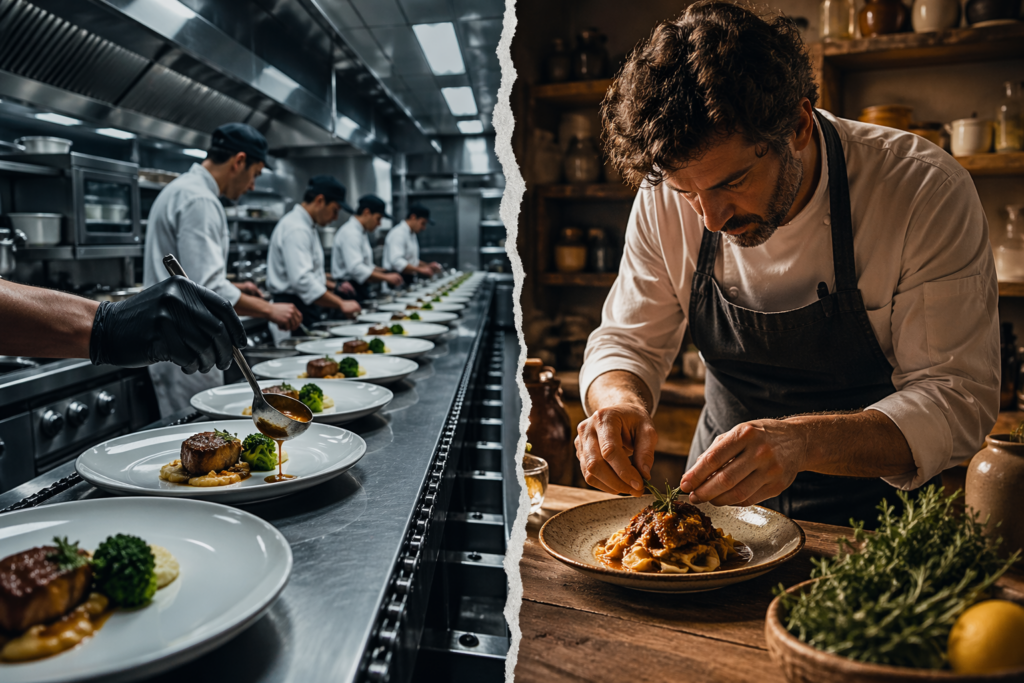
In this scenario, standardization has taken on a central role. More and more kitchens work with ready-made bases, semi-processed ingredients, frozen preps, pre-portioned products, or even dishes to be assembled. I don’t say this in a moralizing tone, because I know well these choices arise from real needs: reducing mistakes, saving time, better employee management, cost control, ensuring consistent results. From an organizational point of view, it’s an understandable solution. But from the point of view of identity, it opens up a huge problem.
When the kitchen becomes too standardized, establishments start to look alike. The dish name changes, the venue design changes, the menu graphics change, but the structure of the experience remains the same. The customer senses order, speed, and predictability, but struggles to actually remember that place. That’s where my deliberately provocative but increasingly unavoidable question comes in: if much of the work is already done upstream, what does the cook become? A creative professional or an executor? An interpreter of cuisine or a precise, fast assembler?
The point isn’t to accuse restauranteurs, but to understand the system
It would be too easy to dismiss everything with a phrase like “the food isn’t as good as it used to be.” I don’t think that’s the point. The real issue is that, in recent years, the restaurant system has come under tremendous pressure. Labor costs have gone up, profit margins have shrunk, it’s harder to find qualified staff, the pace is tougher, and the customer has become both more demanding and less loyal. In this context, standardization isn’t a whim but a defensive strategy.
The problem is that when taken to the extreme, this defensive strategy ends up eroding exactly what makes a place memorable: personality. And in dining, as in many sectors, personality isn’t a romantic detail. It’s a competitive asset. When a restaurant loses recognizability, it enters a danger zone: it might work in the short term, but it struggles to build loyalty, reputation, and differentiation over the long term.
Slowness can still be a value
That’s why I still believe another path exists. It’s more demanding, less immediate, harder to industrialize—but deeply relevant. It’s the path of places with few seats, a clear offering, a recognizable cuisine, and a strong identity. Places where people are even willing to wait a few more minutes, as long as that wait brings an experience that makes sense. Places where not everything is designed to accelerate, but to create space for a truer relationship between the food, the service, and the atmosphere.
In this framework, slowness isn’t inefficiency. It’s a cultural and strategic choice. It’s the opposite of anonymity. It’s what allows a restaurant to remain a place instead of sinking into mere food provision. And I believe that here lies the deepest value of authentic osterias and trattorias today: it’s not about nostalgia, but about offering a coherent, recognizable, human experience even now.
Chains and franchises: are they really condemned to standardization?
But the question can’t stop at small venues. That would be too easy. The interesting point is to ask whether more structured models, like chains and franchises, can also reclaim some of this authenticity. I think so, but only under a very clear condition: they must stop investing only in processes and start seriously investing in people. Because it’s one thing to replicate a dish, another to transmit an approach to interpreting it. And that difference changes everything.
A franchise can also aim for a cuisine with more identity, stronger local ties, and greater credibility, but it can’t really do that if it continues to rely solely on pre-packaged foods, operations manuals, and time control. Training is needed. Internal culture is needed. There has to be a vision that gives dignity to cuisine as a language and not just a production function. This does require more investment, for sure, but it can create an advantage much greater than that offered by simple standardization.
Maybe it’s not about a lack of staff, but a lack of recognition for the craft
When I hear people say there’s a shortage of workers in the sector, I often wonder if the problem is really only about numbers. Maybe it’s not just a shortage of people: what’s missing is recognition. If the cook is seen as interchangeable labor, forced to follow procedures with no room for thought, sensitivity, or growth, it’ll be harder and harder to find motivated, proud people ready to build a serious professional path. If instead, they go back to being seen as interpreters of cuisine, as figures able to read the territory and turn it into experience, then the job changes face.
I’m not idealizing the profession, nor ignoring how tough kitchen life is. What I’m saying is there’s a huge difference between treating cooks as mere manpower and recognizing them as creative figures. And this difference affects not only the quality of the dishes, but also the sector’s ability to attract talent, retain skills, and build long-lasting projects.
And what about marketing? Can it help those who focus on quality and tradition?
Yes, and here I think we get to a key point. marketing can be extremely helpful, but only if it stops being used as a façade. It isn’t meant to cover up a lack of identity; it serves to make that identity visible, understandable, and desirable. A restaurant that focuses on the quality of tradition, on slowness, on care, on genuine cooking, shouldn’t chase after communication models that don’t belong to it. It should learn to tell its story coherently because it’s this very coherence that generates trust and differentiation.
Beautiful photos of dishes, well-edited reels, or a superficial social media presence aren’t enough. A deeper story is needed. You have to explain why that place exists, what vision it has, where its offering comes from, what relationship it has with the territory, with people, with raw materials, with time. Marketing, in this sense, doesn’t create authenticity, but it can help communicate it well. And today, this ability is fundamental, because a quality venue that doesn’t know how to tell its story risks seeming less interesting than a standardized venue that communicates better.
Experience is true positioning
In the end, I believe this is the key point: today, you don’t just compete with the dish, but with the overall experience. And experience, in food, is a form of positioning. It’s what makes a customer remember you, talk about you, come back to you, and recommend you to others. Cooking well is not enough. You need to be recognizable. You need to have a tone, a rhythm, a presence, a clear promise. You need to make people feel that behind that dish is a thought, not just a process.
That’s why I don’t believe the future belongs only to those who are faster or more standardized. I believe it will also, and perhaps above all, belong to those who know how to defend a kitchen with identity, give value back to the people who make it possible, and build a coherent story around this choice. In a market where everything tends to look alike, the real strength is not to do as others do. It’s having the courage to be recognizable.
If you too are trying to build or reposition a project in the food industry without turning it into “just one of many,” maybe the point isn’t just what you serve, but what you represent. And this is exactly where marketing, when done right, can make the difference. If you want to work on the identity, positioning, and communication of your project, you can request a free consultation.
Usiamo cookie per ottimizzare il nostro sito web ed i nostri servizi.
Funzionale
Always active
L'archiviazione tecnica o l'accesso sono strettamente necessari al fine legittimo di consentire l'uso di un servizio specifico esplicitamente richiesto dall'abbonato o dall'utente, o al solo scopo di effettuare la trasmissione di una comunicazione su una rete di comunicazione elettronica.
Preferenze
L'archiviazione tecnica o l'accesso sono necessari per lo scopo legittimo di memorizzare le preferenze che non sono richieste dall'abbonato o dall'utente.
Statistiche
L'archiviazione tecnica o l'accesso che viene utilizzato esclusivamente per scopi statistici.L'archiviazione tecnica o l'accesso che viene utilizzato esclusivamente per scopi statistici anonimi. Senza un mandato di comparizione, una conformità volontaria da parte del vostro Fornitore di Servizi Internet, o ulteriori registrazioni da parte di terzi, le informazioni memorizzate o recuperate per questo scopo da sole non possono di solito essere utilizzate per l'identificazione.
Marketing
L'archiviazione tecnica o l'accesso sono necessari per creare profili di utenti per inviare pubblicità, o per tracciare l'utente su un sito web o su diversi siti web per scopi di marketing simili.