Overly Long Restaurant Menus: Why Streamlining Your Dishes Can Boost Marketing and Enhance Customer Choice
Overly long restaurant menus, customer experience, food marketing: today, more isn’t always better when it comes to driving sales. In this article, I explore why endless menus can weaken your brand identity, perception, and the quality of the guest experience—and how offering less can actually become a competitive advantage.
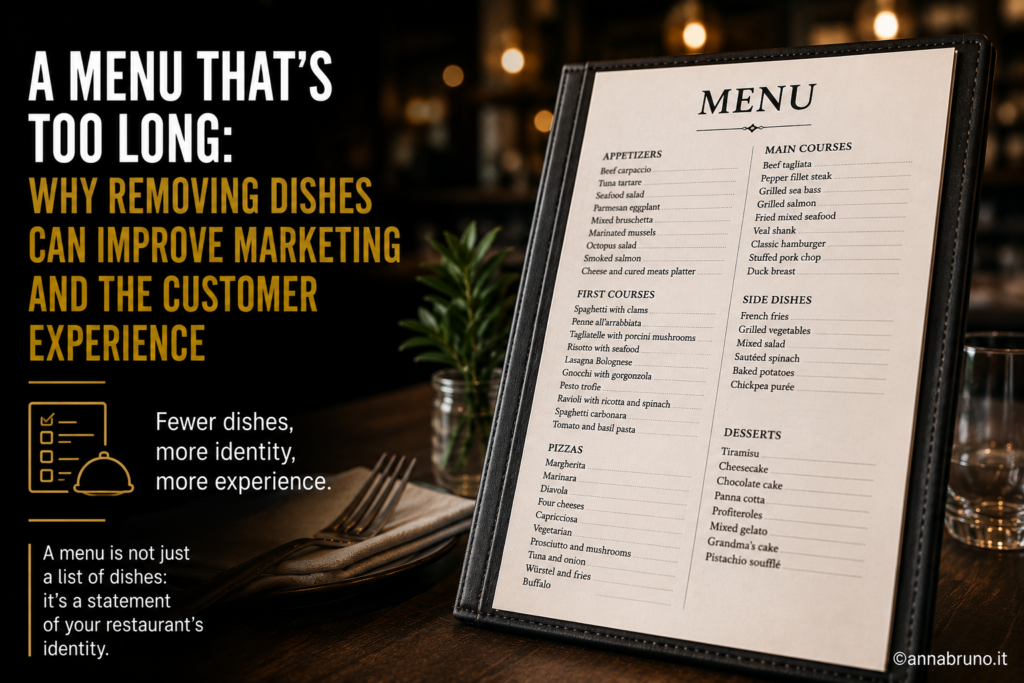
There are menus that, as soon as you open them, already tell you everything. Not so much because of what they offer, but for the sheer number of things they try to be at the same time. Pizza, meat, fish, burgers, sushi, traditional cuisine, gourmet dishes, elaborate desserts, vegan options, regional specialties, and maybe even international cuisine all in the same place. More and more often, when faced with menus like these, I find myself thinking something very simple: when a restaurant tries to do everything, it risks not actually leaving anything behind.
Summary
For years, the restaurant industry has chased the idea that offering more choices automatically meant offering more value. More dishes, more ways to please everyone, more chances not to lose customers. But today something is changing. Customers are no longer just looking for variety: they’re looking for identity.
And this is where the menu stops being just an operational tool and becomes a tool for marketing, perception, and positioning.
The menu is a declaration of identity
Many restaurateurs still think of the menu as just a list of dishes. In reality, the menu says much more. It tells the vision of the restaurant, how it wants to be perceived, the way it relates to cuisine, the territory, and the customer. A menu that’s too long inevitably communicates one thing: an attempt to appeal to everyone. But when you try to please everyone, you risk no longer being recognizable.
This is an issue that affects many restaurants today. Venues that may be well organized, with carefully managed communication, updated social media, proper branding, but lacking a clear direction. The customer eats well, leaves satisfied, but after a few days struggles to really remember the place. And this is exactly where marketing comes into play. Because today, functioning well is no longer enough. You have to leave something memorable.
More dishes don’t automatically mean more value
There is also a very interesting concept in marketing: when options become too many, making a choice becomes harder. This is why many menus end up having the opposite effect to the one intended. Instead of reassuring, they confuse. Instead of communicating abundance, they convey dispersion. The customer is faced with pages and pages of dishes and, unconsciously, starts to wonder: is it really possible to do everything well?
Of course, there are exceptions. There are well-structured restaurants, with large teams and solid organization, capable of managing very extensive menus while maintaining high quality. But in most cases, the endless menu becomes a compromise built so as not to give anything up. And when a venue never gives anything up, it often gives up the most important thing: having a clear personality.
In recent months I’ve often talked about the standardization of cuisine and the risk of turning the chef into a mere executor. I also spoke about it in this in-depth look at the standardization of Italian cuisine and the relationship between experience and identity. Even the issue of overly long menus, deep down, stems from the same problem: the difficulty in choosing what you really want to be.
When the menu becomes a warning bell
There is also another aspect that many customers perceive, even without being restaurant experts. When a venue offers dozens and dozens of à la carte dishes, it’s hard to imagine a kitchen that truly prepares everything to order. More often, the customer unconsciously associates that model with make-ahead preparations, frozen sauces, pre-cooked bases, or standardized components.
This isn’t necessarily a criticism. It’s an organizational model created to address real problems: timing, staff, margins, continuity of service. But it inevitably changes the perception of the experience. You notice this especially when you return to the same place several times and order the same dishes. Everything appears perfectly identical, replicated, unchanging. On one hand, this reassures because it eliminates mistakes; on the other, it also eliminates interpretation, the personal touch, personality.
And it’s precisely here that many restaurants slowly start to become interchangeable.
Customers are changing faster than restaurants
Meanwhile, the public is evolving. Today, people aren’t just looking for a good dish. They’re looking for a context, an atmosphere, a consistent identity. They want to feel like they’re in a place that has something unique. For this reason, venues with smaller, more readable menus are on the rise. Fewer dishes, maybe seasonal, maybe truly built around a cooking philosophy. Places where the customer perceives a deliberate choice, not a constant attempt to please everyone.
It’s the same logic that is now rewarding many contemporary trattorias, bistros, small local restaurants, and recognizable kitchens. Places where you might wait a few extra minutes, but what arrives on your plate still seems to have meaning.
In the end, the modern customer doesn’t just want to eat well. They want to remember where they have been.
Reducing the menu can be a strategic choice
Many restaurateurs see taking dishes off the menu as a loss. In reality, in many cases, it can become one of the smartest decisions from a marketing point of view. Reducing the number of dishes often means increasing perceived quality, improving kitchen management, lightening operational work, and making the restaurant’s identity clearer. But most of all, it means helping the customer understand who you are more quickly.
A more essential menu communicates confidence. It communicates a direction. It communicates a clear choice. And today, in a market where more and more restaurants are beginning to look alike, being recognizable is worth much more than having a hundred options.
Marketing also needs to stop chasing everything
This topic also applies to communication. Many venues today publish content continuously, but without a clear direction. Reels, photos, stories, sponsored posts: all technically correct, but often lacking any real identity.
I also talked about this in the article dedicated to what to post on social media for a restaurant: the problem is not posting too little, but posting without a recognizable thread. It’s the same mistake made by many overly long menus. They try to say everything at once and end up not leaving anything truly memorable.
Even marketing today should learn to subtract. Fewer random contents, fewer confused messages, less endless chasing of trends. More identity, more consistency, more ability to tell what really makes a venue unique.
In the end, what the customer remembers is a feeling
I believe that today many restaurants are faced with an important choice. Continue to pile things on, trying to be everything to everyone, or become more readable, more consistent, more recognizable. Because in the end, the customer will hardly remember how many dishes were on the menu. Rather, they will remember how they felt in that place, what they perceived, whether that restaurant really had something unique of its own.
And in a world where everything risks looking the same, maybe the real luxury isn’t having more choices. It’s still having a clear identity.
If you want to work on your restaurant’s positioning and build communication that is more consistent with your identity, you can request a free consultation.
Usiamo cookie per ottimizzare il nostro sito web ed i nostri servizi.
Funzionale
Always active
L'archiviazione tecnica o l'accesso sono strettamente necessari al fine legittimo di consentire l'uso di un servizio specifico esplicitamente richiesto dall'abbonato o dall'utente, o al solo scopo di effettuare la trasmissione di una comunicazione su una rete di comunicazione elettronica.
Preferenze
L'archiviazione tecnica o l'accesso sono necessari per lo scopo legittimo di memorizzare le preferenze che non sono richieste dall'abbonato o dall'utente.
Statistiche
L'archiviazione tecnica o l'accesso che viene utilizzato esclusivamente per scopi statistici.L'archiviazione tecnica o l'accesso che viene utilizzato esclusivamente per scopi statistici anonimi. Senza un mandato di comparizione, una conformità volontaria da parte del vostro Fornitore di Servizi Internet, o ulteriori registrazioni da parte di terzi, le informazioni memorizzate o recuperate per questo scopo da sole non possono di solito essere utilizzate per l'identificazione.
Marketing
L'archiviazione tecnica o l'accesso sono necessari per creare profili di utenti per inviare pubblicità, o per tracciare l'utente su un sito web o su diversi siti web per scopi di marketing simili.