Home » Blog » Digital Travel » Social Media and Customer Care in Food and Tourism: A Practical Guide
Social Media and Customer Care in Food and Tourism: A Practical Guide
In food and tourism, social media have also become channels for support, relationship-building, and sales. Handling questions, complaints, private messages, and reviews properly means improving the customer experience and protecting the brand’s reputation. Here’s how to set up an effective social customer care strategy, from response times to using artificial intelligence.
In food and in tourism social media are no longer just channels through which to tell the story of a restaurant, a hotel, a destination, or an experience. They have also become places for connection and, increasingly often, true and proper customer care. A question left under a post, a message on Instagram, a complaint published on Facebook or a request received after watching a Reel can affect the brand’s perception just as much as an advertising campaign.
Summary
The change is significant because on social media customer support often happens in plain sight. An effective response can strengthen a company’s reputation. A wrong response (or silence) can produce the opposite effect. For restaurants, hospitality businesses, tour operators, and tourism organizations, it becomes therefore necessary to consider social customer care as part of the social media marketing strategy for tourism and food, not as an extra task to manage only when there’s time left.
What is social customer care
Social customer care includes all customer assistance and relationship-building activities with customers, guests, and travelers that take place through social media platforms. It’s not only about complaints. It begins well before the purchase and can continue long after the experience.
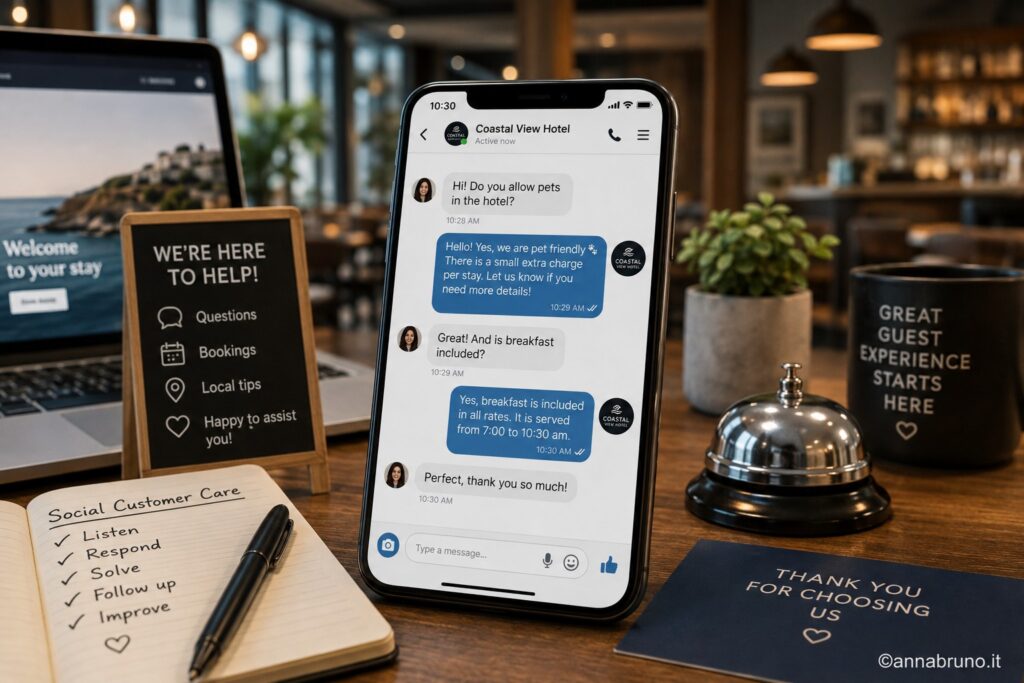
A person might write to a restaurant to find out whether vegetarian dishes are available on the menu, ask a hotel if it accepts pets, ask a tour operator how demanding an excursion is, or contact a destination to understand how to get to a place using public transport. These are seemingly simple requests, but they often come at a time very close to the decision.
That’s why I also consider customer care on social media a conversion tool. Behind a question there might be a customer deciding whether to book with us or turn elsewhere. Social customer care therefore enters the tourism funnel that accompanies the traveler from discovery to booking.
In food and tourism, customers need answers before they buy
Food, hospitality e tourism all share a particular characteristic: the customer purchases an experience that, in most cases, they can’t verify before. A room can be shown through photos and videos, a menu can be published online, and an excursion can be described in the smallest detail—but part of the purchase is inevitably tied to trust.
That’s exactly where social media come into play. Before booking, the potential customer observes how the company communicates, reads comments, checks the responses given to other people, and if they have a doubt, they can choose to message directly. The quality of the response therefore becomes part of the experience even before the experience begins.
A hotel that responds accurately to a question about parking communicates organization. A restaurant that handles a request related to a food intolerance with care communicates attention. A tour operator that immediately clarifies what an excursion includes reduces uncertainty. A DMO that provides genuinely useful information about connections shows that it knows the territory it promotes. It’s the same principle on which good content marketing for travel and tourism businesses: inform, guide, and reduce uncertainties before the decision.
Customer care starts with listening
Managing customer support through social media doesn’t simply mean monitoring the inbox. Conversations can arise in different places: under a post, in the comments to a Reel, via a story, in a private message, or within a discussion where the brand is mentioned. That’s why the first activity should be listening. You need to know where requests are coming from and decide who should handle them.
In a small business, the same person who manages social media may handle this. In more complex organizations, however, it’s necessary to define a workflow: who intercepts the request, who has the necessary information, and who is authorized to respond.
The lack of this kind of organization creates a situation I know well: the social media manager sees the question, asks internally for information, nobody replies, and the customer is left waiting. From their perspective, though, there is no internal process at all. They only see a company that doesn’t respond.
How quickly do you need to respond on social media?
There is no universal timeframe that works for every organization, but on social media expectations are generally higher than with email. Someone using a chat or sending a direct message tends to view that channel as immediate. This doesn’t mean you should promise support 24/7 if you can’t guarantee it. Instead, it means setting realistic expectations and organizing yourselves to meet them.
If a business responds only during certain hours, it can say so clearly. If a request requires verification, it’s better to send a first reply explaining that you’re gathering the information rather than leaving the customer with no response at all. Speed, however, should not replace quality. A very fast but inaccurate response can create a problem far more serious than a few minutes of waiting.
Reply in public or move the conversation to private?
This is one of the most important decisions in social customer care. Not all conversations should be immediately moved to private messages. If someone asks a question publicly that could also be useful to other users, replying publicly creates value. Information about opening hours, services, booking methods, or details of an experience can be relevant to many other people who are reading without commenting.
The conversation should be moved to private when it requires personal data, booking details, payment information, or when the complexity of the case makes it less useful to continue through a sequence of comments. A good rule is ” reply publicly to what can be useful publicly and handle privately what concerns the individual customer
Even when you need to move the discussion, I would avoid the classic impersonal message “contact us privately” as the only answer. It’s better to acknowledge the request first and explain why more information is needed.
How to handle a public complaint
Eventually it happens. A customer writes that they waited too long at the restaurant, that the room didn’t match expectations, that a service fell short, or that something went wrong during an excursion. The first mistake is automatically treating the comment as an attack. The second is replying impulsively to defend the business. When a complaint is public, the response isn’t meant only for the person who posted it. Potential customers who are evaluating the brand will read it too. At that moment, they’re especially observing how a problem is handled
An effective response should acknowledge what has been reported, avoid confrontational tones, verify the facts, and suggest a concrete way to look into the situation further. This doesn’t mean automatically admitting responsibility that doesn’t exist. It means showing that the organization takes what’s been reported seriously.
If personal information or booking details are needed, the discussion can continue privately. But it’s still useful to leave a public trace of being in charge of the case. On this topic, I also explored how to respond to comments and reviews without losing customers.
When the customer is wrong
This is one of the most delicate aspects. In tourism and hospitality, there are also unfounded complaints, partial reconstructions, and expectations that don’t match the service the customer purchased. In these cases, responding doesn’t mean “taking the customer’s side.” It means calmly explaining the facts, without turning the social media page into a courtroom.
If a service wasn’t included in the booking, you can clarify that. If the opening hours were communicated correctly, you can specify it. If a specific condition was mentioned in the offer, you can remind them. The difference is the tone. An aggressive reply can turn a minor objection into a reputational problem. A firm, well-documented, respectful response, on the other hand, also helps people reading from the outside understand what happened.
Don’t automatically delete negative comments
The temptation to delete an uncomfortable comment is understandable, but it’s almost always counterproductive. A legitimate criticism doesn’t disappear just because it’s deleted. The customer can repost it, take a screenshot, or move it to another channel—adding to the original problem the accusation of censorship as well.
Moderation is, of course, necessary when insults, threats, spam, discrimination, or content that violates community rules appear. A negative comment, however, doesn’t automatically fall into these categories. A profile where even critical comments are handled well can end up being even more credible than a seemingly perfect page.
Customer care for restaurants: social media often comes before the booking
In the restaurant industry, the questions received on social media are often extremely specific. The customer wants to know whether there’s availability, whether there’s a menu for certain dietary needs, whether they can bring their dog, whether the venue has outdoor tables, whether it’s suitable for children, or whether they organize something for a particular evening.
Many of these details should already be easily found on the website and on social media profiles. When the same question keeps coming up, then, I don’t consider it only as a request to manage: it’s also a communication signal
If ten people ask whether the restaurant has parking, maybe that information should be made more visible. If many people ask how you handle allergies, you might need a dedicated section. Customer care thus becomes a valuable source for improving content and, more generally, the customer’s digital journey. In fact, even small points of friction can turn into lost bookings, as I explained when analyzing why some restaurants lose bookings due to wrong digital choices.
Hotels and accommodation facilities: every question can hide a booking
For an accommodation facility, the journey can be even more apparent. Someone sees a room on Instagram, opens the profile, visits the website, and then comes back to social media to ask a question. They may be very close to booking already. A generic reply like “all the information is on the website” risks interrupting a process that was almost reaching conversion. If the customer chose to ask a question, they probably didn’t find the information on the website, or they want confirmation.
Responding in a useful way doesn’t mean replacing the booking engine with Instagram. It means guiding the customer to the next step. Having traffic isn’t enough if the journey can’t turn interest into action—a topic I also cover in the article on how to turn visits into customers in tourism and food.
Tour operators: from the social message to the sale
For tour operators, requests can be more complex: availability, dates, group composition, difficulty of the itinerary, included services, insurance, cancellation conditions, transfers. In this case, social media should become a gateway—not necessarily the place where the entire sales process ends.
The role of customer care is to understand the request, provide the first necessary information, and direct the person to the most suitable channel to complete the booking. The step must, however, be simple. Forcing a potential customer to start from scratch by filling out a form where they have to repeat everything they just wrote creates friction.
DMOs and destinations: customer care is also hospitality
For a DMO, the issue is different because often there is no direct sale. This doesn’t make customer care any less important. On the contrary, a destination that communicates on social media inevitably also becomes an information point of reference. How do I get there? Where can I park? Is the museum open? Can I reach that village without a car? Where can I find information about the event? Are guided tours available? Answering well already means providing digital tourist hospitality
A destination may share extraordinary photos, but if it can’t help travelers when they’re looking for practical information, it creates a disconnect between the promise and reality. Promotion and hospitality shouldn’t be two separate worlds. Focusing only on attracting visitors and ignoring what happens in the later stages is also one of the communication mistakes in tourism marketing that I consider most relevant.
The questions received on social media must become content
This is one of the most interesting uses of social customer care. Recurring questions represent a free, ongoing market research effort. If users always ask the same things, those questions can become FAQs, articles, Reels, featured Stories, website pages, or sections of product listings.
A restaurant can turn requests about food intolerances into dedicated content. A hotel can create a guide on how to reach the property. A tour operator can explain in a video what a “medium difficulty excursion” really means. A DMO can create a page dedicated to getting around without a car.
In this way, customer care doesn’t just solve problems: it fuels the editorial strategy. Real questions help you understand which content people truly need and can become one of the starting points for a strategy of content marketing built on the audience’s real needs.
A tone of voice is needed even for support
Many companies define the tone of voice for posts and then forget it when they have to reply to people. The result is curious: warm, recognizable communication in the content, bureaucratic answers in the comments. Social customer care should be consistent with the brand identity, but with one priority: clarity. No elaborate formulas are needed. You need human, understandable, and situation-appropriate responses. An angry customer doesn’t need smiling emojis. A person who simply asks for opening hours doesn’t need to receive a press-release-style text.
Templates, yes. Copy-paste answers, no
Preparing response guidelines and templates is helpful—especially when multiple people manage the channels. It helps maintain consistency and deal more quickly with recurring situations. The problem starts when the template becomes obvious.
Receiving the same standard sentence regardless of the question communicates disinterest. Templates should therefore provide structure, not replace the ability to read and understand what a person wrote.
AI and automations in social customer care
Artificial intelligence can be very useful in managing customer care, especially for organizations that receive many requests. It can help classify messages, identify recurring themes, suggest replies, translate requests coming from international travelers, and quickly recognize situations that require attention. I’d be much more cautious with fully automatic responses in sensitive cases.
A complex complaint, a problem during a trip, an economic dispute, or an emotionally sensitive situation require context and responsibility. AI can assist the agent, but it shouldn’t become an excuse to remove human involvement. In tourism, this aspect is even more important because behind a request there may be someone who is far from home, has missed a connection, can’t reach the property, or is dealing with an issue during their experience.
When the social media manager can’t respond
One of the most common organizational mistakes is delegating customer care to whoever manages social media without giving them access to the information they need. The social media manager can’t invent availability, commercial conditions, refund procedures, or operational information. They must know who to contact and within what timeframes. That’s why, even in a small organization, it’s worth setting at least:
who answers ordinary requests;
who handles bookings and commercial matters;
who steps in in case of a complaint;
which situations must be flagged immediately;
which information cannot be communicated publicly.
You don’t necessarily need a fifty-page manual. You just need responsibilities to be clear.
How to tell if social customer care is working
Simply counting the number of messages received tells you very little. It’s more useful to observe what happens to the conversations and whether the organization can manage them effectively. Among the indicators I consider most interesting are the average time to first response, the number of requests resolved, conversations correctly transferred to bookings or support, recurring topics, and the evolution of sentiment in problematic situations. In general, when measuring social media, I prefer indicators tied to real outcomes rather than simple vanity metrics: it’s the criterion I apply even when analyzing the performance of social media marketing activities in tourism and food.
For activities that sell directly, it’s also useful to understand how many social conversations contribute to a booking. Attribution won’t always be perfect, but asking the customer how they got there or using trackable links can already provide interesting insights.
From customer care to customer experience
Treating social media only as a megaphone means using just a small part of its potential. In food and tourism, these are places where people discover, ask questions, compare options, book, share stories, and—sometimes—complain. All these conversations generate valuable information.
A good social customer care system doesn’t only help you respond faster. It helps you understand where customers run into difficulties, what information is missing, which services create doubts, and which aspects of the experience are appreciated the most. This is where support stops being a separate function and becomes part of the customer experience.
Frequently asked questions about social customer care in tourism and food
What is social customer care?
It is the management of customer requests, questions, comments, and inquiries through social media. It can relate both to the stage before purchase and support during and after the experience.
Do we need to respond to every negative comment?
An authentic criticism generally deserves a response. Spam, insults, threats, and content that violates community guidelines, however, require a different type of moderation. The assessment should depend on the content, not simply on whether the comment is positive or negative.
Is it better to respond publicly or privately?
Useful information for other users can be shared publicly. When personal data, booking details, or confidential information are involved, it’s best to continue the conversation in private.
Can artificial intelligence handle customer care on social media?
AI can help categorize requests, suggest replies, translate messages, and identify recurring issues. In complex or sensitive cases, however, it’s important to keep human oversight.
Can social customer care increase bookings?
Yes. In food and tourism, many questions come in while the customer is evaluating a purchase. A timely, accurate, and helpful response can reduce uncertainty and guide them toward booking.
A conversation on social media can be worth more than it seems
When someone writes “do you have availability on Saturday?”, “can I come without a car?” or “is this experience suitable for a six-year-old?”, it’s easy to see that message as a minor daily hassle. I see it instead as a moment in the customer relationship.
Behind that question there may be a booking, a future review, a customer who will come back, or someone who will tell others how they were treated. In tourism and dining, reputation is built that way too: one conversation at a time. That’s why social customer care shouldn’t be improvised. It must be part of the digital strategy for travel and food with the same care given to content, campaigns, and promotion.
Usiamo cookie per ottimizzare il nostro sito web ed i nostri servizi.
Funzionale
Always active
L'archiviazione tecnica o l'accesso sono strettamente necessari al fine legittimo di consentire l'uso di un servizio specifico esplicitamente richiesto dall'abbonato o dall'utente, o al solo scopo di effettuare la trasmissione di una comunicazione su una rete di comunicazione elettronica.
Preferenze
L'archiviazione tecnica o l'accesso sono necessari per lo scopo legittimo di memorizzare le preferenze che non sono richieste dall'abbonato o dall'utente.
Statistiche
L'archiviazione tecnica o l'accesso che viene utilizzato esclusivamente per scopi statistici.L'archiviazione tecnica o l'accesso che viene utilizzato esclusivamente per scopi statistici anonimi. Senza un mandato di comparizione, una conformità volontaria da parte del vostro Fornitore di Servizi Internet, o ulteriori registrazioni da parte di terzi, le informazioni memorizzate o recuperate per questo scopo da sole non possono di solito essere utilizzate per l'identificazione.
Marketing
L'archiviazione tecnica o l'accesso sono necessari per creare profili di utenti per inviare pubblicità, o per tracciare l'utente su un sito web o su diversi siti web per scopi di marketing simili.