I never choose a tool just because it’s trendy: my method for destinations and restaurants
Digital tools, tourism destinations, restaurants, and strategy: there is no single “best” platform overall, but the one that’s best suited to your goals, organization, and people. In this article, I explain the method I use to evaluate software, automations, and digital services—without confusing the tool with the solution.
The client asks for a tool, but almost never is the actual problem the tool itself
One of the questions I get most often when working with restaurants, accommodation facilities, or tourist destinations is apparently very simple: which software should we use? It could be a booking system, a CRM, a reputation platform, a content management tool, an app, marketing automation, or an AI-based solution. The question almost always comes after the client has already seen a platform, received a commercial proposal, or observed what other operators in the sector are doing.
Summary
It’s understandable. Tools are visible, have attractive interfaces, and promise efficiency, automation, control, and growth. They show tidy dashboards, seemingly simple workflows, and measurable results. It’s far easier to imagine solving a problem by buying a software than by pausing to look at processes, people, responsibilities, and goals. Yet in most cases, the choice of tool should come much later.
Before asking me which tool to use, I prefer to understand which problem they want to solve. It sounds like an obvious distinction, but it’s not. A restaurant might ask for a CRM because it wants to build customer loyalty, but still not have a proper procedure in place for collecting contacts. A destination might want to create an app without defining who will update it, what content it will offer, and why a tourist should download it. A hotel might buy a marketing automation platform without having organized data, clear segments, or an editorial strategy capable of feeding the workflows.
In all these cases, the tool doesn’t solve the problem. It only makes it more expensive, more complex, and sometimes harder to recognize.
There is no single best tool
One of the most common digital misconceptions is thinking that there’s always a platform that’s better than the others. The best solution for managing bookings, the most complete CRM, the most advanced software for a destination, the most effective tool for social media or reputation. In reality, a tool is only valid in relation to the context in which it will be used.
A platform can be excellent from a technological standpoint and completely unsuited to the organization that buys it. It may have dozens of features, sophisticated integrations, and advanced automations, but it can also require skills, time, and continuity that the company doesn’t have. Another tool, which seems simpler, may produce better results because it’s understood, used, and maintained by the people who work on the project every day.
That’s why I never start with a comparison of features. I start with goals, resources, and processes. Only after that do I evaluate whether the platform is truly compatible with the reality it should serve.
It’s the same principle I apply when analyzing projects at the outset. In the article dedicated to my method, I explained that “},{why I no longer accept projects without an initial analysis. Choosing software before you’ve understood the problem means starting from the solution and hoping that, sooner or later, it meets the actual need. It’s a way of working I prefer to avoid today.
The first criterion: what problem does it really need to solve?
Before evaluating a tool, I try to translate the initial request into a concrete problem. “We need a CRM” is not yet a problem. “We’re losing the contacts of people who have already stayed with us and we can’t build a relationship over time” is. “We need a tourism app” is a solution. “Visitors can’t easily find up-to-date information about experiences, mobility, and local services” is a problem that needs to be analyzed.
This distinction completely changes the work. If the problem is losing contacts, a CRM might help, but it may be enough to fix the data collection and management process. If destination information is scattered, an app might be an answer, but it may be more useful to work first on the website, the structure of the content, distribution, and coordination among operators.
One question I often ask is: what would happen if we didn’t buy any new tool at all? It’s a useful question because it forces a distinction between what is truly necessary and what merely seems desirable. In some cases, it emerges that the problem can be solved by organizing existing platforms better. In others, on the contrary, it becomes clear that a new tool is essential because key functions are missing. The software should come when the need is clear enough for us to assess its effectiveness. Not before.
The second criterion: who will use it every day?
A tool isn’t used by an abstract organization. It’s used by specific people, with very concrete schedules, skills, habits, and responsibilities. This is one of the most underestimated aspects during selection.
A restaurant can buy a sophisticated platform to manage customers, bookings, reviews, and promotional campaigns. But who will enter the data? Who will check the information? Who will reply to messages? Who will build the campaigns? Who will verify that consents have been collected correctly? If these questions don’t have answers, the platform risks becoming an incomplete archive or a paid subscription with no real use.
For a destination, the challenge is even more complex. The stakeholders involved can be numerous: public administration, DMO, consortium, operators, guides, accommodation facilities, museums, associations, and external providers. A platform might be technically suitable, but it can fail because it hasn’t been defined who owns the content, who updates it, who checks quality, and who takes responsibility for the project over time.
So when I evaluate a tool, I don’t just look at the interface. I try to understand whether the people who will have to use it will truly be able to integrate it into their daily work. The best software is often the one that’s used consistently, not the one that has the most features on the sales page.
Available features and truly usable features
Digital platforms are often sold through very long lists of features: automations, segmentation, artificial intelligence, dashboards, integrations, predictive analytics, notifications, and personalization. But the presence of a feature doesn’t mean the organization is in a position to use it.
To take advantage of advanced segmentation, you need enough data—collected correctly and kept up to date over time. To run effective automations, you need content, rules, responsibilities, and oversight. To use a dashboard, you must know which metrics to monitor and which decisions to make based on the data. To introduce artificial intelligence, you need clear processes, reliable materials, and people who can verify results.
The gap between what the tool can do and what the organization will actually do is one of the most important hidden costs. Often, companies pay for dozens of features and use only two or three. Not because they can’t, but because the software was chosen without evaluating the project’s digital maturity level.
Good consulting should also help to adjust expectations. Not always is the most powerful solution the most useful. Sometimes it’s better to choose a simpler tool, build a stable process, and move to a more advanced platform only when the organization is truly ready.
Restaurants and destinations don’t have the same needs
Talking generically about “tools for tourism and food” can be misleading. A restaurant and a tourist destination may share some goals, but they have very different structures, audiences, and processes.
For a restaurant, priorities may involve managing bookings, direct customer relationships, reputation, the menu, customer loyalty, collecting contacts, organizing the dining room, delivery, or communication. Every tool must also be assessed for how well it simplifies the work without making the experience colder or more impersonal.
For a destination, however, governance comes into play, as well as coordination among operators, content distribution, territorial data, the accessibility of information, building itineraries, engaging stakeholders, and ensuring project continuity beyond individual funding periods. A destination platform can’t be evaluated simply by looking at what appears to the tourist. You need to understand how the content is collected, verified, and updated, who takes part, and what operating model supports the system.
In both cases, the risk is choosing the tool by looking at the final result and ignoring all the work needed to keep it alive. A beautiful interface doesn’t guarantee up-to-date content. A well-designed app doesn’t automatically create a community. An efficient booking platform doesn’t automatically build a relationship with the customer.
Ownership of data: the question that’s asked too late
When evaluating a tool, one of the first questions should be: who owns the data? Yet in practice, this question often comes up only when the relationship with the platform breaks down, when the service increases costs, or when the company decides to migrate elsewhere.
In the restaurant and hospitality sector, this issue is particularly delicate. Platforms can bring visibility, bookings, and simplification, but they can also become intermediaries in the customer relationship. If the business can’t access the data, export it, use it in compliance with consents, and transfer it to other systems, the value built over time remains partly in the hands of the provider.
That’s why I always check which data is collected, where it’s stored, what format it can be exported in, who can use it, and what happens at the end of the contract. I also evaluate whether the tool enables real integrations or creates a closed ecosystem from which it becomes difficult to exit. Ownership of data isn’t a minor technical detail. It’s part of the strategy.
Integrations: it’s not enough that they exist on paper
Many platforms claim they integrate with dozens of services. It’s an important element, but it must be carefully verified. An integration can be native, partial, available only in the most expensive plans, or it can depend on external services that add costs and complexity.
Before choosing a tool, I try to reconstruct the ecosystem that’s already in place: website, booking system, CRM, newsletter, analytics, social media, back-office system, channel manager, advertising platforms, and internal tools. The new software must fit into this system—or it will force people to duplicate data, export files, update multiple repositories, and manage parallel processes.
Duplication is one of the clearest signs of an unsustainable choice. If a booking has to be copied manually into three platforms, if content has to be updated separately on the website, app, and portal, or if the data doesn’t communicate with each other, the technology is adding work instead of reducing it. In some cases, the perfect integration doesn’t exist and you have to accept a compromise. But that compromise must be known before purchase, not discovered while using it.
Visible costs are only part of the picture
The subscription price is the easiest cost to compare, but it’s rarely the decisive one. A tool also involves configuration, data migration, training, personalization, content production, support, maintenance, and human time. A seemingly inexpensive platform can become costly if it requires many hours of manual work. A more expensive system, however, can be sustainable if it eliminates duplication and simplifies important processes. That’s why I never consider the subscription fee in isolation.
I also evaluate the minimum contract duration, feature limits, and costs linked to the number of users, contacts, locations, bookings, or sends. I check what happens when the business grows, because many tools are convenient at the beginning but become much more expensive as volumes increase.
There’s also a less visible cost: the cost of abandonment. When an organization invests time in training, transfers data, and modifies its processes, changing platforms becomes difficult. It’s a real cost, even when it doesn’t show up on the invoice.
The tool’s sustainability over time
Many tools are chosen during an initial phase of enthusiasm. The presentation works, the features seem to answer every need, and the project starts with energy. After a few months, however, usage declines. Information isn’t updated, automations remain inactive, and the platform becomes just another forgotten set of credentials.
To avoid this outcome, I try to imagine the tool not on the day of setup, but after one year. Who will keep using it? How much time will it require each week? What will happen if the key person changes jobs? Is the documentation sufficient? Is the support reliable? Can the project continue without depending completely on the provider or a single consultant?
Sustainability also relates to the platform’s business model. A very young software can be innovative, but have fewer guarantees of continuity. A more established service can be stable but less flexible. There’s no one-size-fits-all answer, but the risk must be assessed.
In digital, novelty attracts. Continuity creates value.
Security and privacy can’t be added after the fact
When a tool collects bookings, personal data, preferences, payments, or information about user behavior, security and privacy become an essential part of the selection. They can’t be fully delegated to the provider without knowing how they’re handled.
I verify which data is collected, which servers it’s stored on, what roles and permissions are available, whether there is multi-factor authentication, activity logs, backups, and exports. I also evaluate GDPR compliance, consent management, and the ability to comply with requests for access, modification, or deletion.
For a small restaurant, these aspects may seem overly technical. In reality, they become concrete when an unauthorized access occurs, when an employee keeps using credentials after leaving the business, or when customers’ data can’t be retrieved. A simple but secure platform is often preferable to an advanced solution managed without oversight.
Support matters more than the demo
Demos almost always show the software in its best possible condition. Everything is tidy, fast, and intuitive. The real quality of a provider shows up, however, when something doesn’t work—when data migration is needed, an incompatibility must be resolved, or a function is unclear.
That’s why I consider support as part of the product. I assess the language of the support, response times, available channels, the quality of documentation, and whether there is an updated knowledge base. I also look for reviews that talk about what happens after the sale—not just the initial experience. For complex projects, especially in destinations, I also evaluate the provider’s willingness to understand the context, personalize workflows, and support the people involved. Standard technology may be fine, but a territorial project often requires mediation and training capabilities that go beyond the software.
The tool should help the customer—not just the organization
Another common mistake is choosing tools while looking only at internal needs. Reducing workload, automating, centralizing, and controlling are important goals, but you also need to look at what changes for the customer. A booking system can be very convenient for the restaurant and complicated for someone trying to reserve a table. An app can collect many functions and require tourists to go through registration, permissions, and unnecessary steps. A chatbot can reduce requests to support, but become a barrier when it can’t understand even a simple question.
Technology should simplify the experience, not transfer work from the organization to the customer. Every added step, every form that’s too long, and every registration requirement must have a precise reason.
This also applies to digitalizing the restaurant industry. In the article about “how to digitize a restaurant I highlighted that technology should improve the experience and organization, not become an end in itself.
Automation doesn’t mean the absence of people
One of the main reasons companies look for new tools is automation. Automating can reduce repetitive tasks, improve punctuality, and make some processes more reliable. But not everything should be automated in the same way. In tourism, food, and hospitality, the human relationship remains a central part of the experience. Automatic confirmation is helpful. A standard response to a complex request can be counterproductive. An email flow can accompany the customer, but if it ignores the context, it risks feeling intrusive.
When I assess an automation, I try to understand where the system needs to replace a manual activity and where, instead, it should help a person work better. The most effective tool isn’t the one that eliminates the greatest number of people, but the one that allows them to spend more time on the activities where human input creates value.
When it’s better not to buy anything
One of the most useful conclusions of an analysis is deciding not to purchase a new tool. It’s not a defeat and it doesn’t mean giving up on innovation. It means recognizing that, at that moment, the problem isn’t due to a lack of technology.
Sometimes it’s enough to configure an existing tool better. Other times it’s necessary to remove duplicate platforms, clarify responsibilities, or train people. In some cases, the project still doesn’t have enough data, content, or processes to justify more advanced software. Buying too soon can create the illusion of being more organized, but it often only adds another layer of complexity. I prefer a simple, clear process that people actually use over a sophisticated ecosystem that no one can manage.
The method I use to choose digital tools
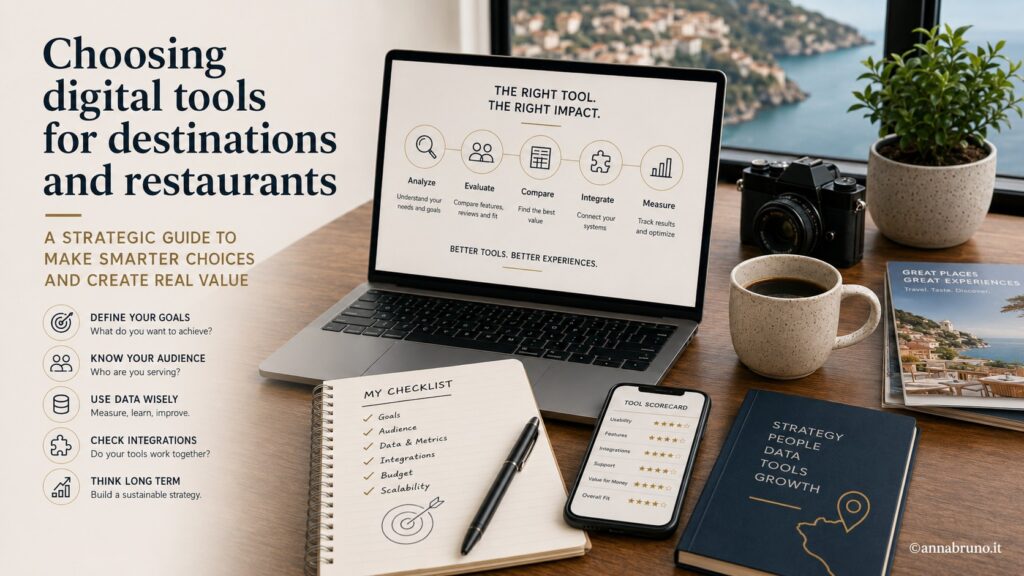
My method doesn’t start with a ranking, and it doesn’t end with the name of the one that’s most well-known. It begins with analyzing the problem, the processes, the people, and the goals. Next comes defining the essential requirements, distinguishing them from desirable but non-essential functions.
After that, I evaluate compatibility, integrations, data ownership, security, total costs, support quality, sustainability, and impact on the customer experience. Only then do I compare platforms, request targeted demos, and, when possible, use trial periods or small pilot projects.
A trial is important because it allows you to observe the tool’s real behavior. A function may seem simple during the presentation but turn out to be not very intuitive in everyday use. An integration may exist formally but fail to transfer all the data that’s needed. An automation may require more control than expected. In the end, the choice isn’t only about technology. It’s about the organization’s ability to adopt it, govern it, and turn it into a concrete result.
Conclusion: the tool comes after direction
I never choose a tool because it’s trendy, because competitors use it, or because it promises to solve everything. I choose it when it addresses a real problem, fits into the processes, is used by people, and helps achieve a measurable goal.
In tourism, hospitality, and destinations, technology can create enormous value. It can simplify bookings, improve the customer relationship, make information accessible, coordinate operators, collect data, and support better decisions. But it works only when it’s built into a strategy.
That’s why, before comparing platforms and features, I always come back to the same question: what problem are we trying to solve? As long as this answer isn’t clear, any software risks being just a solution looking for a problem. If you need to choose or reorganize digital tools for a restaurant, accommodation facility, or destination, you can request “},{initial consulting to analyze processes, priorities, and real needs before investing in a new platform.
Usiamo cookie per ottimizzare il nostro sito web ed i nostri servizi.
Funzionale
Always active
L'archiviazione tecnica o l'accesso sono strettamente necessari al fine legittimo di consentire l'uso di un servizio specifico esplicitamente richiesto dall'abbonato o dall'utente, o al solo scopo di effettuare la trasmissione di una comunicazione su una rete di comunicazione elettronica.
Preferenze
L'archiviazione tecnica o l'accesso sono necessari per lo scopo legittimo di memorizzare le preferenze che non sono richieste dall'abbonato o dall'utente.
Statistiche
L'archiviazione tecnica o l'accesso che viene utilizzato esclusivamente per scopi statistici.L'archiviazione tecnica o l'accesso che viene utilizzato esclusivamente per scopi statistici anonimi. Senza un mandato di comparizione, una conformità volontaria da parte del vostro Fornitore di Servizi Internet, o ulteriori registrazioni da parte di terzi, le informazioni memorizzate o recuperate per questo scopo da sole non possono di solito essere utilizzate per l'identificazione.
Marketing
L'archiviazione tecnica o l'accesso sono necessari per creare profili di utenti per inviare pubblicità, o per tracciare l'utente su un sito web o su diversi siti web per scopi di marketing simili.