Home » Blog » Digital Travel » When digital marketing harms reputation: real cases I experienced firsthand
When digital marketing harms reputation: real cases I experienced firsthand
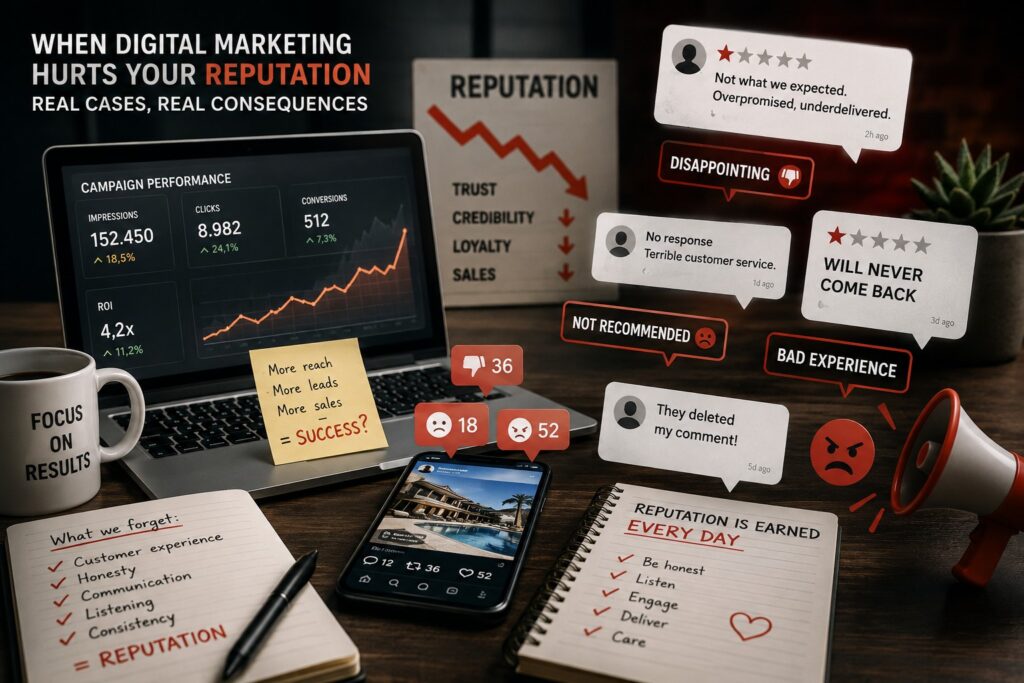
Digital marketing should build visibility, relationships, and trust. Sometimes it produces the opposite effect: aggressive automation, incorrect responses, unkept promises, and number-focused strategies can damage a company’s reputation. Based on situations I’ve personally witnessed, I analyze the most common mistakes—and, above all, how to avoid them.
Digital marketing should help a business be found, known, and chosen. It should build relationships, strengthen trust, and make it easier for a person to move from the first contact to the purchase. And yet, over the course of my work, I’ve repeatedly seen the opposite phenomenon: digital activities created to increase visibility and sales that end up hurting the brand’s reputation.
Summary
I’m not necessarily talking about major reputation crises or campaigns that end up in the newspapers. Much more often, the damage comes from a sum of small mistakes: a wrong reply, an overly persistent automation, an excessive promise, a sales message out of context, a poorly handled review, or a communication that tells a story about a company that’s very different from what the customer encounters in real life. Taken individually, these can seem negligible; repeated over time, they change the brand’s perception.
That’s also why I believe digital marketing is much more than a set of tools to generate traffic, leads, and conversions. Every digital touchpoint communicates something about the business and, for better or worse, contributes to its reputation.
When marketing works in the numbers but damages the brand
One of the most common misunderstandings is to consider a strategy effective just because it produces measurable results. A campaign can generate a lot of clicks, a Reel can reach thousands of people, a newsletter can achieve a good open rate and an automation can produce many contacts. None of this data, taken on its own, tells us what perception we’re building.
I can increase email opens using a aggressive subject line and simultaneously annoy part of the database. I can get lots of comments by posting a provocative piece of content and attract an audience completely outside my positioning. I can multiply sales messages and get a few more sales in the short term, while some customers start to see the brand as intrusive.
The problem arises when we measure only what’s easy to count. Reputation is slower, less obvious, and much harder to represent in a dashboard—but it can have economic consequences far more lasting than a single campaign.
First case: when automation turns into insistence
I’ve seen companies enthusiastic about the possibilities offered by automations. The principle was correct: a person takes an action, enters a flow, and receives follow-up communications designed to guide them toward conversion. The problem was the amount and rigidity of the sequence. The user had downloaded a resource or requested information, and from that moment on they started receiving emails, reminders, offers, and further nudges. If they didn’t respond, the system kept going. Technically everything worked perfectly. But from the point of view of the person receiving those messages, the company became progressively more annoying.
Automation should never make us forget that on the other side there’s someone who may not necessarily follow the path we’ve designed. They might have changed their mind, already purchased elsewhere, may not be ready yet, or may simply not want to receive any more follow-up. Technology allows us to automate many activities, but we should ask ourselves: what should we automate without deteriorating the relationship?
Second case: a social reply that makes the problem worse
Another scenario I’ve encountered several times involves negative comments. The customer reports a problem, and the company immediately interprets that signal as an attack on its image. The response becomes defensive, sometimes even polemical, and in the attempt to protect the reputation, you end up damaging it even more.
This happens especially when the person replying is emotionally involved in the activity. It’s understandable: reading a criticism of your restaurant, hotel, product, or service publicly can be irritating—especially when you believe the customer’s account is unfair. But the audience watching the conversation doesn’t necessarily know all the facts. It mainly evaluates the behavior of both parties.
As I explained also when talking about how to respond to comments and reviews, handling criticism well doesn’t mean automatically giving the customer reason. It means demonstrating professionalism even when you need to contest the facts.
In social media marketing, a reply no longer belongs only to the conversation between the company and the customer: it becomes public content and can be read, screenshotted, shared, and found again long after.
Third case: promising online more than the experience can deliver
This is a particularly clear problem in tourism, hospitality, and food service. Spectacular photos, emotional copy, carefully edited videos, and advertising campaigns can build very high expectations. If the real experience doesn’t match the digital promise, though, the quality of the communication paradoxically becomes part of the problem.
This doesn’t mean a hotel has to publish bad photos or that a restaurant shouldn’t enhance its dishes. It means the communication should highlight the product without inventing a different one. A room photographed in a way that makes it look enormous, a view that seems immediately accessible from the property when it isn’t, an experience presented as exclusive when it involves dozens of people—these create a gap between expectations and reality.
The stronger the promise, the greater the disappointment can be when it isn’t kept. And today, that disappointment quickly comes back online in the form of reviews, user photos, comments, and videos.
Fourth case: trying to look like something the company isn’t
I’ve also seen strategies built around a digital identity completely different from the organization’s real culture. On social media, the company appeared informal, close to people, friendly, and contemporary. When the customer came into contact with the organization, though, they found rigid procedures, cold communication, and very long response times. The problem wasn’t the tone used on social media. It was the lack of consistency between communication and the organization.
A brand isn’t only what we decide to tell. It’s also what the customer experiences when they call, send an email, enter a point of sale, arrive at the hotel, ask for help, or try to resolve an issue. That’s why marketing and customer experience can’t proceed as two completely separate activities.
Fifth case: the customer becomes a number to chase
When pressure to deliver results increases, it can happen that every interaction is interpreted exclusively in terms of conversion. Someone downloads a document and becomes a lead. They visit a page and are added to remarketing. They abandon a cart and receive a reminder. They interact with a piece of content and are reached again.
Each of these activities can perfectly make sense. The problem arises when they overlap without considering the overall experience. The same person may receive emails, ads, notifications, and commercial messages at the same time—and feel like the brand is chasing them. A good “funnel accompanies a person from discovery to conversion; it shouldn’t drag them into buying. The difference may seem subtle, but in the customer’s perception it’s enormous.
When customer care becomes marketing too
One of the aspects I find most interesting is the increasingly blurred boundary between marketing, sales, and support. A person can discover a company on Instagram, ask for information via a private message, visit the website, book, and then return to the same social platform to request help. From their point of view, there are no departments. There’s just one brand.
That’s why a brilliant campaign can’t indefinitely compensate for poor support. On the contrary, good relationship management can become one of the most effective forms of marketing. In the article dedicated to the “social customer care in food and tourism I delved into exactly how questions, complaints, and digital conversations contribute to the customer experience.
Sixth case: deleting what you don’t like
Another reaction I’ve encountered is the temptation to make the problem disappear. A negative comment appears and is deleted. A criticism shows up and the user is blocked. An uncomfortable review is treated as something to remove rather than a signal to analyze. Of course, there’s spam, insults, discriminatory content, and behaviors that must be moderated. A legitimate criticism, however, doesn’t belong in this category. Deleting it can turn an unsatisfied person into an angry one, who may repost the content elsewhere, possibly also mentioning that they were censored.
Moreover, a page made up exclusively of perfect enthusiasm isn’t necessarily more credible. The ability to handle a problem publicly can convey far more trust than an apparently spotless reputation.
Seventh case: communicating without listening
Many digital strategies are still built almost entirely on outbound communication. The company decides what it wants to say, prepares the editorial calendar, publishes, sponsors, and measures. Meanwhile, though, customers and users are continuously providing information through comments, reviews, research, questions, and support requests.
Ignoring these signals means giving up an enormous amount of knowledge. If many people ask the same question, then the information is probably not clear enough. If a specific complaint keeps coming back, there may be an issue with the experience. If customers use different words than the company’s chosen ones, perhaps the communication language should also be rethought. Digital marketing shouldn’t be only the ability to speak to the audience, but also the ability to listen to it.
Reputation often breaks in the details
When people talk about online reputation, they easily think about major crises: the wrong post going viral, an influencer publicly criticizing a company, a campaign that faces backlash, or a snowstorm of negative reviews. In most cases I’ve observed, however, the deterioration is much quieter. A customer doesn’t get a reply. Another finds contradictory information. A third receives too many emails. Someone reads an arrogant response to a review. A potential customer lands on a landing page that promises something they don’t end up finding. None of these episodes on its own seems enough to talk about a reputational crisis. Together, though, they build a perception. And that’s the difficult part: when the commercial results start to suffer, the problem may have started long before.
How to prevent digital marketing from damaging your reputation
I don’t think you need extremely complicated procedures. First of all, you need to change perspective and assess digital activities not only from the company’s point of view, but also from that of the person receiving them.
Look beyond immediate metrics: clicks, opens, engagement, and conversions are important, but they must be read together with the quality of interactions and the perception of the brand.
Keep commercial pressure in check: email, remarketing, notifications, and automations should be considered as parts of the same experience.
Align promise and experience: what’s communicated online should be recognizable when the customer actually meets the company.
Prepare those who respond: comments, reviews, and complaints shouldn’t be handled impulsively or without information.
Use criticism as data: not all of it will be justified, but repeated patterns can point to real problems.
Maintain human oversight: automations and AI can help, but delicate situations require context and responsibility.
Rely on professionals with proven experience: when the strategy involves reputation, customer experience, automations, and managing critical issues, it’s important to choose consultants who have long, hands-on experience and can interpret not only the data, but also the consequences that certain choices can have on the brand over time.
In other words, reputation should be considered as one of the effects to measure when designing a digital strategy—not something to deal with only when a problem arises. That’s also why, especially in the most delicate projects, I believe it’s important to rely on professionals with proven experience, able not only to assess what can generate results in the short term, but also the impact those choices will have on how people perceive the brand over time.
AI and reputation: a new risk to manage
Artificial intelligence makes this topic even more important. Today we can generate content, answers, emails, descriptions, and interactions at a speed that just a few years ago would have been unthinkable. We can also automate an increasingly large part of the relationship with customers and potential customers. But increasing the volume of communications also increases the chance of getting it wrong. An automated reply that’s out of context, a clearly standardized text, or a chatbot that can’t understand a delicate situation can immediately convey a sense of distance.
So I don’t see AI as a reputation problem in itself. The risk arises when it’s used to indiscriminately replace the human relationship rather than to improve it. The more powerful automation becomes, the more important it is to establish where it should stop.
Frequently asked questions about digital marketing and reputation
Can digital marketing damage a company’s reputation?
Yes. Overly aggressive communications, promises that don’t match real experience, poor review management, intrusive automations, and inappropriate responses can negatively change how people perceive a brand.
What are the most dangerous digital marketing mistakes for reputation?
Among the most common are excessive sales pressure, lack of listening, defensive management of criticism, inconsistency between communication and experience, and indiscriminate use of automations.
Does a negative review always damage reputation?
No. A negative review handled professionally can even strengthen the trust of those observing the conversation. It’s not only the criticism that affects reputation, but also the way the company responds.
Can automations and AI harm the brand?
They can, when they produce excessive, impersonal, or out-of-context communications. Used with control and integrated with human intervention, however, they can improve efficiency and service quality.
How do you protect online reputation?
Reputation is protected by maintaining consistency between what the company promises and what it delivers, listening to customers and users, handling critical issues correctly, and assessing the impact of digital activities on the entire customer experience.
Before the next campaign, I would also look at the other side
When I design or evaluate a digital strategy, therefore, I wouldn’t just ask how many clicks it can generate, how many people we can reach, or what conversion rate we can achieve. I would also ask what impression we leave people during the journey. It’s a question that’s less easy to include in a report, but it can be much more important in the long term. Because a campaign ends, an ad stops running, and a Reel quickly disappears from the feed. The perception a person has built about the company, on the other hand, can remain.
The best digital marketing isn’t the one that simply manages to get attention. It’s the one that, after earning it, can turn it into trust without sacrificing reputation for one more conversion.
Usiamo cookie per ottimizzare il nostro sito web ed i nostri servizi.
Funzionale
Always active
L'archiviazione tecnica o l'accesso sono strettamente necessari al fine legittimo di consentire l'uso di un servizio specifico esplicitamente richiesto dall'abbonato o dall'utente, o al solo scopo di effettuare la trasmissione di una comunicazione su una rete di comunicazione elettronica.
Preferenze
L'archiviazione tecnica o l'accesso sono necessari per lo scopo legittimo di memorizzare le preferenze che non sono richieste dall'abbonato o dall'utente.
Statistiche
L'archiviazione tecnica o l'accesso che viene utilizzato esclusivamente per scopi statistici.L'archiviazione tecnica o l'accesso che viene utilizzato esclusivamente per scopi statistici anonimi. Senza un mandato di comparizione, una conformità volontaria da parte del vostro Fornitore di Servizi Internet, o ulteriori registrazioni da parte di terzi, le informazioni memorizzate o recuperate per questo scopo da sole non possono di solito essere utilizzate per l'identificazione.
Marketing
L'archiviazione tecnica o l'accesso sono necessari per creare profili di utenti per inviare pubblicità, o per tracciare l'utente su un sito web o su diversi siti web per scopi di marketing simili.