Why inbound marketing works so well in tourism and food
In tourism and food, people rarely choose after seeing just one advertisement. They search, compare, read reviews, and discover places, products, and stories. That’s exactly why inbound marketing works particularly well in these industries: it captures an interest that already exists and guides it all the way to the final decision.
In tourism and food, people rarely choose after seeing just one advertisement. They look for information, compare, read reviews, watch photos and videos, ask for advice, and discover places, products, and stories. Sometimes this journey takes only a few minutes; other times, it lasts days or weeks. This is exactly why I consider the inbound marketing particularly suitable for tourism and the food industry. Not because it’s a miracle formula, and not because it makes ads and promotions useless, but because it starts from a principle very close to how people make decisions today: to be present with a response, a piece of content, or information when interest arises, instead of constantly trying to interrupt someone in order to get their attention. It’s a seemingly simple difference, but it fundamentally changes how marketing should be designed.
Summary
For a long time, the dominant model was essentially outbound: the company had something to sell and looked for an audience to whom it could offer it. Today, especially in travel and in food, an important part of the journey works in the opposite direction. It’s the person who is searching for a destination, a restaurant, a hotel, an experience, a recipe, a typical local product, or an answer to a question. The real opportunity lies in managing to be found at that moment—and, above all, in earning the right to stay among the options they’re considering.
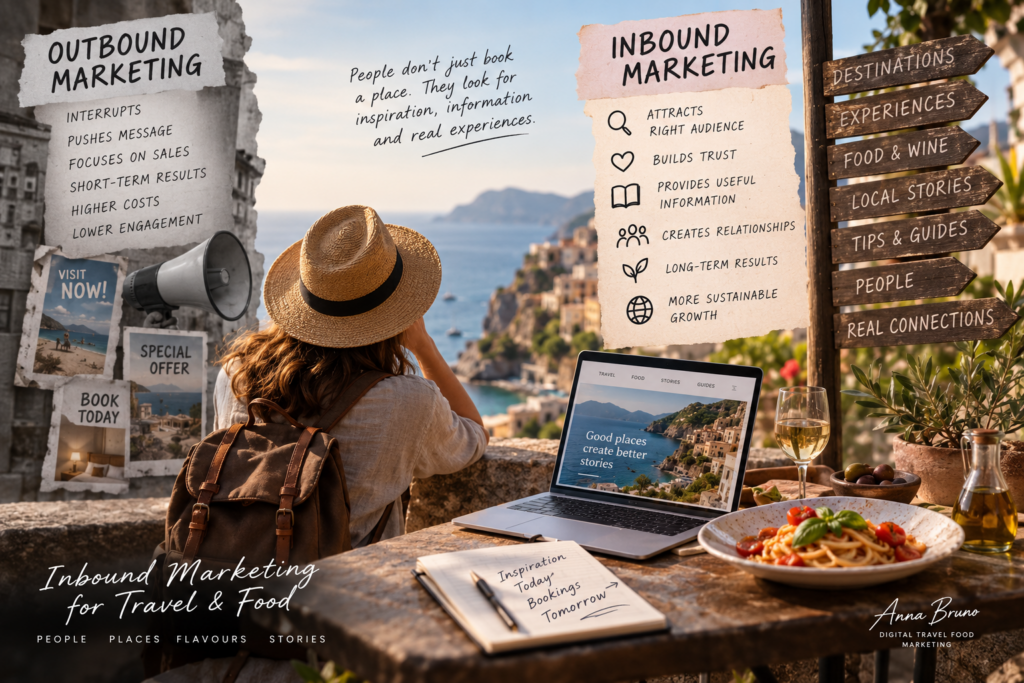
Inbound marketing and outbound marketing: the difference isn’t just in the tools
The distinction between inbound and outbound marketing is often simplified through a list of tools. On one side: blogs, SEO, newsletters, and content; on the other: ads, sales calls, banners, and promotional campaigns. It’s a useful distinction to start with, but it’s not enough. The most interesting difference is the relationship with the person’s attention.
In the outbound model, it’s mainly the company that initiates contact. It buys ad space, sends a message, proposes an offer, shows an advertisement, or reaches a potential customer directly. In other words, it tries to insert itself into someone’s attention. In the inbound model, the starting point is often the opposite: there is already a demand—explicit or latent—and the company creates the conditions to be found during that journey.
A person searches for “romantic weekend in Tuscany,” “what to see in Matera,” “hotel with a spa near…,” “typical restaurant,” “where to eat local cuisine,” “best time to visit…,” or “how to use a specific food product.” At that moment, they aren’t asking to see an advertisement. They’re looking for something. Inbound marketing aims to become part of the answer.
Why the old outbound is showing more and more limits
I don’t consider outbound marketing dead. That would be an oversimplification and, above all, it wouldn’t be true. A good advertising campaign can generate sales, bookings, awareness, and demand. A well-designed promotion can work. Even direct selling activities, in the right context, can produce results.
What I consider increasingly ineffective is a marketing model built almost entirely on interruption: increasing the number of messages, increasing commercial pressure, constantly chasing new audiences, and starting over from scratch every time the budget runs out.
The problem is obvious. People are exposed every day to a huge amount of commercial communication, and they’ve developed an extraordinary ability to ignore it. They skip ads, close pop-ups, delete emails, quickly scroll through sponsored content, and they recognize many promotional mechanisms with ease. This doesn’t mean that advertising is useless. It means that buying exposure doesn’t automatically mean winning attention, trust, or preference.
In tourism and in food this limitation becomes particularly clear because we rarely sell something that can be assessed purely through price and a technical feature. We’re selling experiences, expectations, pleasure, time, places, hospitality, flavors, and—very often—trust.
Outbound buys attention. Inbound builds an asset
This is one of the differences I consider most important. When I buy an advertising campaign, I gain visibility as long as I keep covering its cost. It’s perfectly legitimate and, in many cases, strategically useful. But when I stop investing, I generally stop most of that distribution as well. A good inbound ecosystem works differently.
A useful article published today can be found for months or years. A destination guide can keep reaching travelers. A well-built page can answer a recurring question. A newsletter can build a relationship with people who have voluntarily chosen to receive information. Authoritative content can earn mentions and links. A well-told story can help define a product’s identity. That doesn’t mean all of this is free. It’s one of the most common misunderstandings about the “inbound marketing.
Creating quality content takes time, expertise, and resources. It requires strategy, research, production, distribution, updates, and measurement. The difference is that part of the investment helps build assets that remain with the company. The website, articles, guides, photographs, videos, the properly acquired contact database, reputation, authority, and visibility in search results progressively become a digital asset.
Tourism and food have decision-making processes naturally suited to inbound
To understand why the “inbound” works so well in these sectors, we need to look at what happens before the purchase. Imagine someone planning a vacation. Before booking, they might search for information about the destination, compare times of year, check connections, read guides, watch videos, look for hotels, check reviews, identify restaurants, discover experiences, and save content on social media.
Booking is only the last visible part of a much longer journey. The same happens in food, even if with different timelines. Before choosing a restaurant, we might look at Google Maps, read reviews, check the menu, examine photos, visit Instagram, verify prices and location. Before buying a food product, we may want to understand its origin, producer, characteristics, ingredients, uses, or recipes.
In all these steps, there are questions a brand can answer even before asking for a sale. And that’s exactly the space where inbound marketing lives.
Content enters the buying process before the product
One aspect I find most interesting is that in tourism and food, content doesn’t just play a promotional role. It can become an integral part of the experience that happens before choosing. A guide created by a hotel about what to do nearby doesn’t necessarily talk about the rooms, but it can help a person imagine the stay. A producer’s story doesn’t necessarily contain a promotion, but it can explain why a product has certain characteristics. Restaurant content about the provenance of an ingredient can make sense of a choice present in the menu.
In food marketing, I’ve often highlighted the importance of the story behind the product: not because every product needs artificial storytelling, but because origin, people, method, and territory are often information that contributes to how value is perceived. So content doesn’t simply “keep social media active.” It can reduce the distance between what the company knows about itself and what a potential customer needs to understand in order to choose.
SEO and inbound marketing: getting found when a question arises
SEO has historically been one of the most powerful inbound marketing tools because it allows you to capture existing demand. The difference from many forms of advertising is clear. I’m not randomly showing a hotel to someone who might possibly want a vacation. I’m trying to be present when that person is already searching for useful information to plan the trip. But limiting inbound to SEO would be a mistake today.
The discovery journey has become far more fragmented. A destination can be discovered through TikTok and explored further on Google. A restaurant can be encountered on Instagram, checked on Maps, and booked through the website. A product can be mentioned by a creator, searched for later online, and purchased days afterward. So the job of strategy isn’t to obsessively cover every platform. It’s building a consistent presence at the points that truly matter in people’s journey.
From SEO to AEO: today, being found doesn’t only mean showing up on Google
In recent years, the very concept of search has changed. Traditional search engine pages have been joined by AI-generated answers, conversational assistants, and environments in which the user doesn’t simply receive a list of links, but a summary. That’s why today I consider it important to pair SEO with the AEO applied to tourism: not just think about how to position a page, but how to structure information clearly enough, with authority and verifiability, so it can be understood and used in the new response systems.
For a destination, a hotel, a restaurant, or a producer, this means working on the quality of the information, on how clearly the entity is identified, on data consistency, on the authority of sources, and on the ability to concretely answer people’s questions. So contemporary inbound can no longer be described only through the old path “Google → article → website → conversion”.
Today, discovery can start on a search engine, on a social network, on Maps, on YouTube, or inside an AI-generated response. But the core principle of inbound remains surprisingly current: being useful and recognizable at the moment when someone is looking for something.
Social media: inbound doesn’t mean constantly posting
Another misconception is to associate inbound marketing with the simple production of social. Posting a lot doesn’t mean having an inbound strategy. Having a full editorial calendar doesn’t necessarily mean building demand. And getting engagement doesn’t automatically mean generating business. In foodthis is particularly evident. A very appetizing photo can receive numerous likes without leaving almost anything in people’s memory compared to the restaurant that published it. That’s one of the reasons I reflected on what I learned about online attention while working in the food industry.
An inbound content piece should have a recognizable purpose. It can help people discover, inform, answer a question, demonstrate expertise, build trust, spark curiosity, or guide them toward a decision. Not everything has to sell immediately. But everything should have a reason to exist.
Inbound marketing doesn’t mean passively waiting for the customer
The term “inbound” can lead you to think of a passive strategy: I create content, I publish it, and I wait for someone to come along. That’s not it. A serious inbound strategy requires distribution. Content must be promoted, linked, updated, repackaged, and taken to the places where they can reach the right audience. SEO, social media, newsletters, digital PR, partnerships, creators, and advertising can all work together. The difference is that distribution doesn’t represent the entire strategy. It brings people toward an ecosystem that already has something to offer. This is where inbound and outbound can even stop being adversaries.
Advertising and inbound can work together
.
I don’t see any contradiction between an inbound strategy and the smart use of advertising. Let’s imagine a hotel that has built on its website a very useful guide dedicated to a specific area, a clear page about the available experiences, content capable of answering guests’ questions, and a simple booking path. A campaign can accelerate distribution and bring new users toward that ecosystem.
It’s very different from buying traffic to a page that only offers a rate and a few photos. The same is true for a food producer. A campaign can help people discover the product, but if those who arrive find information about origin, uses, people, features, and purchasing methods, then advertising is no longer forced to do all the persuasive work on its own. Advertising can buy the first meeting. Inbound can give that meeting depth.
The real goal isn’t traffic
.
One of the negative consequences of reading inbound too technically has been an obsession with traffic. More visits, more sessions, more users: certainly important numbers, but not enough. I’ve already covered this topic by explaining why website traffic isn’t enough to generate conversions in tourism and food.
We may be excellent at capturing someone’s search, but terrible at guiding the person through the next step.
An article can drive thousands of visits, but if it doesn’t create a connection to the offering, it remains isolated. A page can rank well, but if it doesn’t communicate trust, it may produce no action. A Reel can generate great attention, but if nobody remembers the brand, the commercial value may be limited. That’s why inbound shouldn’t be measured only by the number of people who enter the system, but also by the system’s ability to guide them.
From visitor to relationship: what happens after the first contact
.
A good inbound strategy doesn’t end when someone lands on the website. That’s only one point along the journey. A destination can invite a person to go deeper into an itinerary. A hotel can offer a useful guide to keep. A tour operator can allow people to receive updates about a specific trip. A producer can offer recipes, product information, or content dedicated to the product. A restaurant can make booking easier or maintain a relationship with those who chose to follow it.
This is where email marketing, CRM, segmentation, and nurturing come into play—but above all, a principle comes into play: don’t treat every contact as if they’re already ready to buy.
A person thinking about spring holidays doesn’t necessarily need to receive an aggressive offer right away. It can be far more effective to guide them with information that helps them progressively build their decision.
In tourism, the time before booking is marketing
.
This aspect is especially important in travel. Often we tend to focus mainly on the booking moment: how many users purchased, which channel converted, which campaign produced the result. But before booking, there may have been a long sequence of interactions. Someone might have discovered a destination months earlier, saved a piece of content, later read a guide, signed up for a newsletter, searched for accommodations, and only then booked. Attributing the entire outcome to the last click means ignoring an important part of the process. And that’s precisely in that earlier stage that inbound marketing can express much of its value.
In food, trust can be worth more than promotion
.
In the food and gastronomy sector, the timeline can be shorter, but the principle remains similar. A person may choose a restaurant because they heard about it, saw its content multiple times, read reviews, observed the chef’s work, recognized some of the products used, and progressively built a positive perception. Or they may buy a product because over time they learned about its origin and features.
In these cases, marketing hasn’t simply generated visibility. It has reduced uncertainty.
I think this is one of the most underestimated functions of inbound marketing. Before trying to persuade, it can help people understand. And understanding makes choosing easier.
The role of reviews and reputation in inbound
.
Then there’s a part of the journey that the company doesn’t fully control: what others say. Reviews, articles, mentions, customer content, creators, word of mouth, and digital PR all contribute to how people perceive the brand. That’s why I consider it limiting to imagine inbound as something that happens exclusively through owned channels. A person may find a restaurant’s website through Google and then check the reviews. They may read an article about a destination and then search for experiences shared by other travelers. They may discover a product on the producer’s website and look for confirmations elsewhere. Inbound works best when what we say about ourselves is also backed up outside our own spaces.
Artificial intelligence will make it even more important to have something to say
. generative AI is dramatically reducing the cost and time needed to produce content. This makes it possible to do much more, but it also generates a huge amount of material that is formally correct and easily replicable. The result, in my view, will be significant for inbound marketing. It won’t be enough to produce fifty articles around the keywords of a sector. It won’t be enough to ask an AI for an editorial plan and publish it automatically. It won’t be enough to fill the website with answers that could be identical across a hundred other domains.
Elements that are difficult to replicate will become increasingly valuable: experience, expertise, original data, knowledge of the area, people, testimonials, direct access to sources, real photos, concrete case studies, and a point of view. AI can multiply production. But precisely for that reason Inbound of the future will have to multiply the quality of information, not simply the amount of content.
Inbound doesn’t mean producing content without a strategy
Another mistake I often see is starting directly with production. “We need to have a blog”, “we need to open TikTok”, “we need to post three times a week”, “we need to do a newsletter”. Strategy comes first. It’s a principle I’ve explored when talking about why strategy should come before content. Without knowing who we want to reach, which questions we can intercept, what our goals are, and what role we assign to different channels, we risk simply producing more. And producing more doesn’t necessarily mean doing more marketing.
An example: the hotel that stops talking only about rooms
Let’s take a small independent hotel. A predominantly outbound communication strategy could focus on offers, rates, availability, packages, and sponsored campaigns. All potentially useful activities. An inbound strategy adds another layer. The hotel can become an authoritative source in its own area: explaining what to do, suggesting itineraries, sharing experiences, answering logistical questions, talking about seasonality, gastronomy, and lesser-known places. It can reach people who haven’t decided where to stay yet because they’re still figuring out what to do.
When the time comes to book, that hotel won’t be just one of the available options anymore. It will already be part of the process through which the person built the trip. For me, this is one of the most interesting applications of inbound in tourism.
An example: the restaurant that stops posting only dishes
The same reasoning can be applied to a restaurant. If all communication consists of food photos alternating with “book your table”, we’re constantly asking something from the audience: attention and conversion. An inbound approach can broaden the story. Ingredients, techniques, people, the area, producers, frequently asked questions, food culture, seasonality, and cooking choices can become opportunities to be discovered and understood. The continuous call to action still exists. But it’s no longer the only reason to communicate. And when the time comes to choose where to eat, part of the work will already have been done.
An example: a destination that doesn’t wait for the tourist to have already decided
For destinations, this principle is even more evident. A destination shouldn’t just communicate events and attractions to people who have already decided to visit it. It can get involved much earlier in the process, intercepting desires and interests: family trips, outdoor tourism, food and wine tourism, villages, walking routes, culture, nature, weekend getaways, seasonal experiences. In this case, content isn’t only meant to inform the tourist who is already there. It can help to even spark the decision to set off. And this is where inbound marketing meets destination marketing, SEO, editorial content, social discovery, PR, and today also AEO.
When outbound continues to be useful
Because I believe inbound is highly effective, I think it’s important to avoid ideological stand-offs. Outbound remains useful when it’s needed to accelerate. To launch an offer, support an event, reach a specific audience quickly, promote a new opening, work on awareness, or recover demand in certain periods. The problem starts when it becomes the only engine. If every customer has to be constantly “re-bought” through advertising, if there’s no qualified organic traffic, if the brand doesn’t have its own audience, if no one searches for the company spontaneously, and if all communication disappears as soon as the ad spend ends, the system is fragile. A more mature strategy therefore combines the ability to intercept demand, build demand, and accelerate demand.
Why I consider inbound particularly suitable for tourism and food
After years of working in these sectors, the point for me is this: tourism and gastronomy have an extraordinary amount of informational and emotional material. Places, people, products, traditions, itineraries, techniques, seasons, experiences, and skills naturally generate questions and curiosity. Reducing all of that to a sequence of promotional messages means giving up an enormous part of marketing potential. Inbound, instead, makes it possible to use that wealth to enter the decision-making process before the sale.
It doesn’t necessarily interrupt someone to tell them “buy this”. It aims to be present when that person is asking “where?”, “how?”, “when?”, “why?”, “which?”, and “what should I choose?”. This doesn’t make inbound easy, fast, or free. It requires time, method, consistency, and a strategy capable of connecting content and business. But it builds something I consider especially valuable: the ability to be found even before being searched for by name.
From interruption to choice
If I had to summarize the difference between the two models in one sentence, I’d say that outbound buys attention, while inbound creates the conditions to be found and chosen. This doesn’t mean you necessarily have to eliminate one in favor of the other. It means understanding what role to assign to each. In tourism and food, where a decision often forms long before booking, purchasing, or the restaurant bill, building those conditions can make a huge difference. Because the most interesting marketing doesn’t start when we ask someone to buy.
It starts much earlier, when we manage to be useful at the moment when that person is still trying to figure out what to choose.
Frequently asked questions about inbound marketing in tourism and food
What is inbound marketing?
Inbound marketing is an approach aimed at attracting and guiding potential customers through useful content, information, and experiences, reaching them during their journey of research and decision rather than relying exclusively on direct promotional messages.
What’s the difference between inbound marketing and outbound marketing?
In outbound, it’s mainly the company that initiates contact through advertising, promotions, or direct communications. With inbound, you create content and touchpoints capable of reaching people who are already showing interest, a question, or a need.
Is outbound marketing outdated now?
No. Advertising, promotions, and direct commercial activities can continue to be effective. They become more fragile when they represent the only driver of the strategy, and every new visibility opportunity depends exclusively on a new investment.
Why does inbound marketing work well in tourism?
Because traveling typically involves a research and comparison phase before booking. Guides, itineraries, answers to questions, destination content, and practical information allow destinations and operators to enter the decision-making process before the purchase.
Why is inbound marketing suitable for the food sector?
Food offers a huge amount of potentially useful content: products, ingredients, producers, techniques, the territory, recipes, and food culture. These elements can generate interest and trust before a booking or purchase is requested.
Are SEO and inbound marketing the same thing?
No. SEO is one of the tools that can support an inbound strategy. Inbound also includes content, social media, email marketing, reputation, digital PR, nurturing, and other touchpoints along the customer journey.
Does artificial intelligence change inbound marketing?
Yes. Information research is increasingly carried out using AI systems and concise answers. In addition, AI makes it much easier to produce content—raising the value of original information, experience, expertise, reliable sources, and identities that are difficult to replicate.
Does inbound marketing mean you don’t use advertising anymore?
No. Advertising and inbound can be complementary. Ads can speed up distribution and bring people into an ecosystem of content, information, and conversion paths that has already been built.
Usiamo cookie per ottimizzare il nostro sito web ed i nostri servizi.
Funzionale
Always active
L'archiviazione tecnica o l'accesso sono strettamente necessari al fine legittimo di consentire l'uso di un servizio specifico esplicitamente richiesto dall'abbonato o dall'utente, o al solo scopo di effettuare la trasmissione di una comunicazione su una rete di comunicazione elettronica.
Preferenze
L'archiviazione tecnica o l'accesso sono necessari per lo scopo legittimo di memorizzare le preferenze che non sono richieste dall'abbonato o dall'utente.
Statistiche
L'archiviazione tecnica o l'accesso che viene utilizzato esclusivamente per scopi statistici.L'archiviazione tecnica o l'accesso che viene utilizzato esclusivamente per scopi statistici anonimi. Senza un mandato di comparizione, una conformità volontaria da parte del vostro Fornitore di Servizi Internet, o ulteriori registrazioni da parte di terzi, le informazioni memorizzate o recuperate per questo scopo da sole non possono di solito essere utilizzate per l'identificazione.
Marketing
L'archiviazione tecnica o l'accesso sono necessari per creare profili di utenti per inviare pubblicità, o per tracciare l'utente su un sito web o su diversi siti web per scopi di marketing simili.