Home » Blog » Digital Travel » What I Learned About Online Attention While Working with the Food Sector
What I Learned About Online Attention While Working with the Food Sector
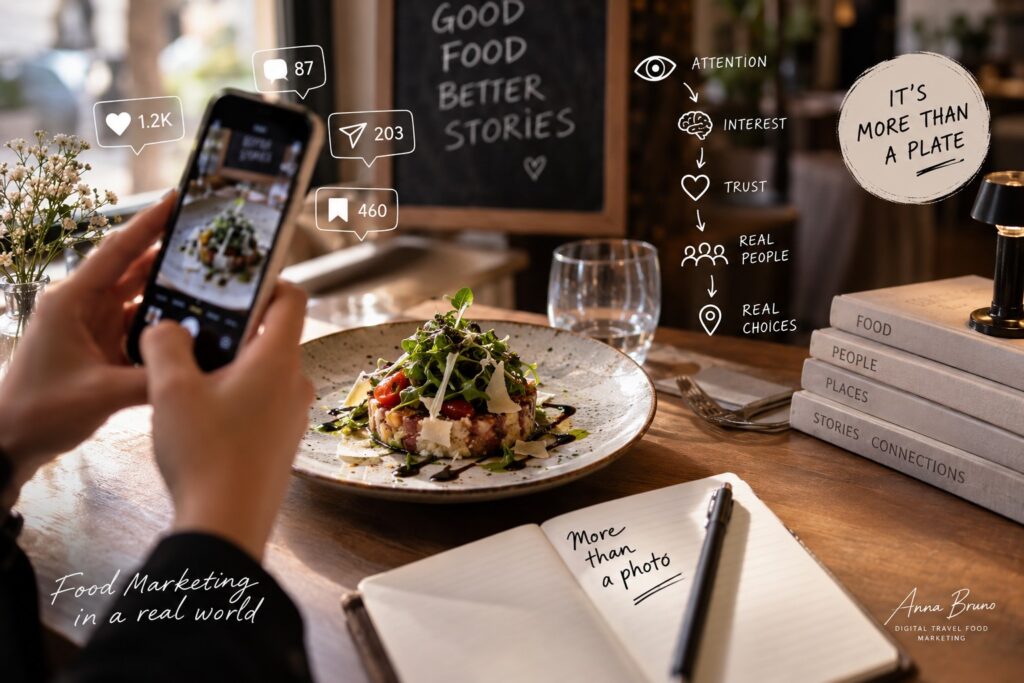
Food seems to have a natural advantage in digital communication: it’s visual, emotional, and immediate. Yet attracting someone’s attention doesn’t mean you’ll win attention, be remembered, or drive a choice. It’s one of the most interesting lessons I’ve learned while working in this industry.
Food seems to have an extraordinary advantage when it comes to digital communication. It’s visual, immediate, emotional. A pizza fresh out of the oven, a well-constructed dish, a slice of dessert, a kitchen preparation can stop the eye much more easily than many products and services that are difficult to convey through an image.
Summary
And yet, after years of working with restaurants, agri-food products, territories, and food-related projects, I’ve understood something that at first may seem almost paradoxical: “being able to catch the eye doesn’t necessarily mean being able to win someone’s attention: and, in turn, winning attention doesn’t mean being remembered, building trust, or prompting someone to choose a restaurant, buy a product, or dig deeper into a brand.
It’s an important distinction because a significant part of digital marketing is still evaluated based on what happens in the very first seconds: impressions, views, likes, clicks, watch time. These are useful signals, of course, but they only tell a few moments of a much more complex relationship. In food, this difference is particularly clear, precisely because getting the first reaction can be relatively easy.
Food catches the eye. But attention is another thing
A great photo of a dish can interrupt—just for a few seconds—the scrolling of a feed. A video featuring an especially mouthwatering preparation can rack up thousands of views. A recipe can be saved, a Reel shared, a photo commented on. All of this has value, but the question that I’m increasingly interested in is the one that comes next: what remains in someone’s mind once the content is gone?
Do they remember the restaurant’s name? Do they know where it is? Did they notice what makes it different from others? Did they learn something about the product? Did they connect that piece of content to a place, a person, a way of working? Or do they simply remember having seen a very beautiful dish?
The difference is huge. In the first case, the content begins to build a relationship with the brand. In the second, it has simply occupied a few seconds of attention within a flow where—just moments later—another ten equally appetizing photos will probably arrive.
That’s why I believe it’s useful to distinguish between visual stimulus and attention. The stimulus triggers a reaction. Attention requires something more: interest, recognizability, curiosity, relevance. And when we talk about content marketing, it’s this second level we should focus on.
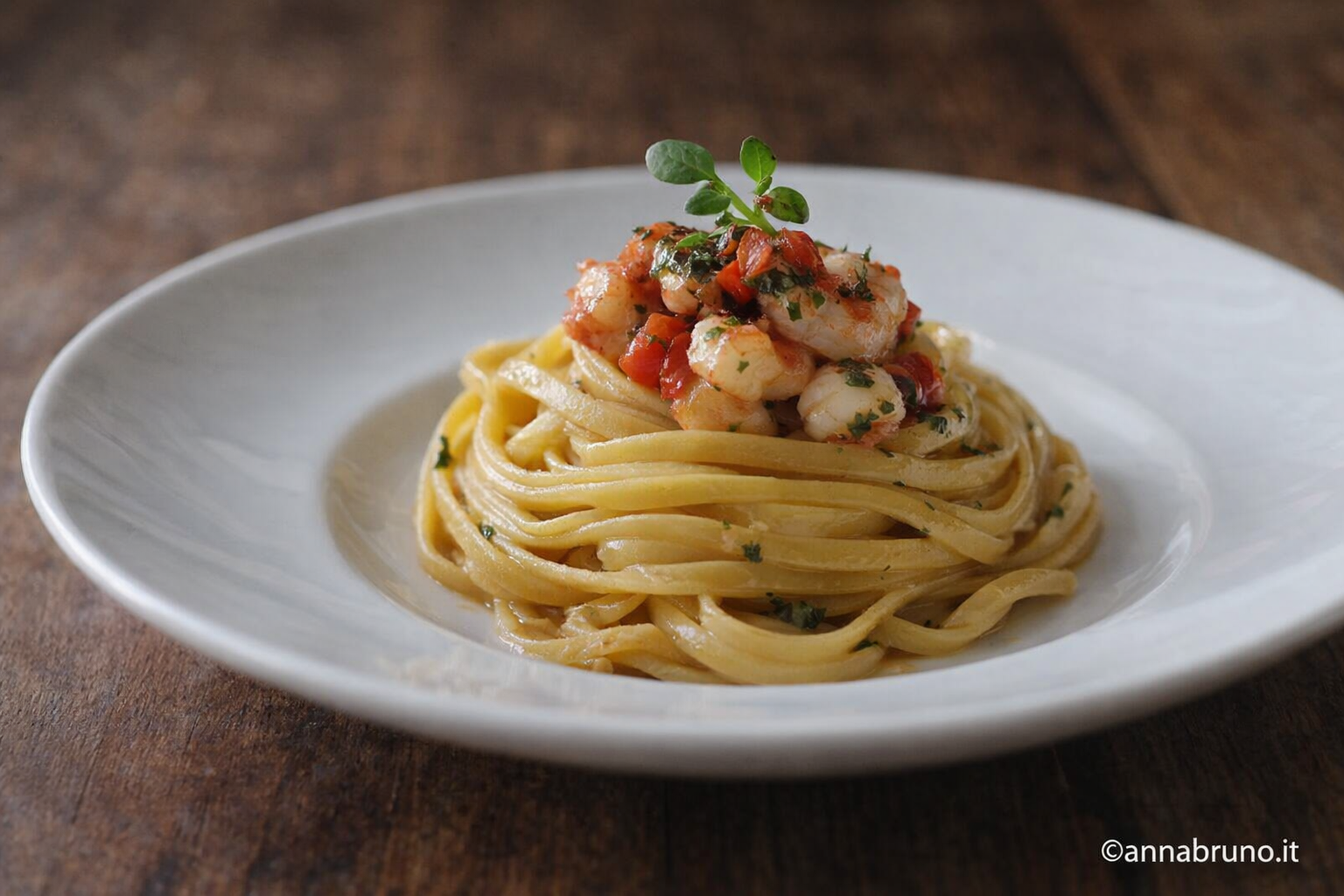
Gourmet pasta dish served in a restaurant, food photography in natural light
When everything looks good, looking good is no longer enough
There was a time when a good food photo could truly be a distinctive element. Today, the average level of visual production has risen enormously. Smartphones produce excellent images, apps correct light and colors in seconds, templates have made graphic design accessible, and artificial intelligence makes it possible to create images and videos of ever-increasing quality.
It’s good news from a technical standpoint. But from a marketing perspective, it creates an interesting effect: when everyone can produce something that’s aesthetically pleasing, aesthetics alone lose some of their power to differentiate.
I see this often when looking at how restaurants and food businesses communicate. Curated profiles, well-corrected photos, inviting dishes, well-edited videos. Taken individually, many pieces of content work. Look at them together, though, and they become surprisingly similar. Change the dish, change the venue, change the music in the Reel, but the narrative structure stays almost identical.
So the problem isn’t necessarily the quality of the content. It’s its interchangeability. If, by removing the restaurant name, a photo could belong to fifty different venues, then we’re probably communicating the product well—but the identity much less so.
In food, content isn’t missing: often what’s missing is a reason to remember it
This is probably one of the lessons I consider most important. In food, there rarely is a problem of scarcity of material to talk about. There are products, ingredients, preparations, people, suppliers, territories, seasons, traditions, techniques, cooking choices, mistakes, experiments, service, environment, customers, recipes, and stories.
And yet, communication often tends to reduce this enormous richness to a photograph of the final result: the dish. It’s understandable. The dish is immediate and easy to show. But telling only what ends up on the table means giving up much of what could make that content recognizable. It’s a topic I’ve also explored while talking about food marketing and the story that exists behind a product: very often, what creates value isn’t just what we sell, but everything that helps people understand its meaning.
A tomato is a tomato until I know the producer, the place where it’s grown, why that variety was chosen, and why the chef decided to use it in that dish. It doesn’t mean turning every ingredient into a novel or building artificial storytelling. It means recognizing that the context makes things less interchangeable.
Attention suffers even when we ask people to choose too much
The attention problem isn’t only about social media or content. In food, I find it in many points of both digital and physical experiences. One obvious example is the menu. When options increase too much, satisfaction doesn’t always rise. What can increase instead is the effort required to decide. I’ve talked about this by analyzing what happens when a restaurant menu becomes too long. But the principle is interesting even when applied to communication: constantly adding new messages, sections, offers, products, and calls to action doesn’t automatically make a digital presence more effective.
Sometimes, it even does the exact opposite. The more things ask for attention at the same time, the less clear it is what that attention should actually focus on. A restaurant might want to communicate the daily menu, Friday’s event, the new pizza, a business lunch, a romantic dinner, delivery, the music night, the new dessert, the local area, the wine that just arrived, and the weekend promotion. All of this is legitimate information. But if everything becomes a priority at the same time, in the end there is no longer any priority. Content marketing is also selection. Deciding what not to talk about today can be just as important as deciding what to publish.
Frequency can’t replace relevance
For a long time, part of social media marketing has been dominated by the idea of frequency: you have to post, you have to be consistent, you have to keep feeding the profile. Consistency is still important, but I believe this guidance has often been interpreted in a too mechanical way.
Being consistent doesn’t mean filling an editorial space. It means building over time a presence that people recognize. If, to stick to a calendar, you continuously post variations of the same content, frequency may even reduce attention: people quickly learn that there’s nothing new to discover. It’s one of the reasons why, when I think about what a restaurant can post on social media, I see the calendar as a tool, not a strategy. It’s meant to organize work, not to justify producing content that serves no purpose. The question shouldn’t be only “What should I post tomorrow?”. First there should be: “Why should someone spend a few seconds on this particular piece of content?”.
Likes, views, and attention aren’t synonyms
Working in food has also taught me to be very cautious when reading metrics. It’s a sector where some content can easily trigger immediate reactions. People like food, it delights, it sparks curiosity. But precisely because of that, it becomes even more important to understand what we’re actually measuring.
A view indicates that a piece of content was shown according to the platform’s criteria. A like signals a reaction. A save can indicate deeper interest. A click adds another layer. A brand search, a request for information, a booking, or a purchase adds even more. None of these metrics is useless. The problem arises when we attribute to a metric a meaning it doesn’t have.
I tackled the same issue when discussing why having traffic on the website isn’t enough to get conversions in tourism and food. Getting someone to a page is an intermediate result. If that person doesn’t find a clear offer, a reason to keep going, enough trust, or an easy path to action, the number of visits can grow without producing a comparable improvement for the business. Something similar happens with attention. We can end up with big numbers and, at the same time, build very little memory.
The creator case: lots of visibility can create little memory
The relationship between attention and outcome is also clearly visible in collaborations with creators and influencers. A person with a large community can put a restaurant or a product in front of thousands of users in a very short time. That’s a valuable capability, but the size of the audience still doesn’t tell us what effect that exposure will have.
That’s why, when I evaluate collaborations with creators and food influencers, I care much more about alignment than just follower count. What kind of audience follows that person? For what reason? How credible are they when they talk about that product? Will the content stay associated with the creator, or will it transfer something to the brand, too?
It’s possible to perfectly remember a video and not remember the name of the venue where it was filmed. It’s possible to follow a creator because they make you smile—and have no intention of buying what they show. And it’s possible for a smaller but strongly consistent community to produce a much more interesting result than an enormous audience. Once again: visibility, attention, memory, and conversion are different stages. Confusing them makes it hard even to understand whether an investment worked.
People pay attention to what helps them understand something
One of the most interesting things I find in content that performs over time is that it often doesn’t just ask for attention—it rewards it. It helps people discover something, resolves a doubt, shows what usually isn’t visible, explains a choice, tells a process, and gives access to expertise.
In food, the possibilities are enormous. Why is a dough left to mature for a certain number of hours? How does an ingredient change over the year? Why is a traditional recipe prepared in a certain way? How do you recognize a raw material? What happens in the kitchen before service? Why did a producer choose one technique instead of another?
This type of content doesn’t necessarily have to be long or educational. It can last twenty seconds. The difference is that at the end of those twenty seconds, the person has something they didn’t have before. That’s where, in my view, attention starts turning into value.
Not everything has to sell, but everything should serve a purpose
Another common misconception is expecting every piece of content to produce immediate conversion. That’s not how it works. Someone might come across a restaurant online many times before deciding to go there. They can discover a product, forget about it, run into it again, read a review, see a recipe—and only then buy. Content can therefore have different functions: to get discovered, explain, reassure, demonstrate expertise, build familiarity, spark desire, answer a question, or make a decision easier. The issue isn’t that every piece of content has to sell. The issue is publishing without knowing what function it should perform.
It’s a distinction I consider fundamental because it also allows you to evaluate results correctly. If a piece of content is created to increase brand awareness, judging it solely by immediate bookings would make little sense. But if a campaign is created to drive bookings for a special dinner, stopping at the number of views would be just as insufficient.
AI makes the attention problem even more obvious
The arrival of generative artificial intelligence has made this topic even more interesting. Producing content has become easier. We can generate images, texts, ideas, copy variations, videos, and editorial plans in timelines that, just a few years ago, would have been unthinkable.
This doesn’t mean that quality is automatic. What it does mean is that the technical barrier to production has lowered. And when it becomes easier to produce, inevitably the amount of what gets produced increases. The result is a paradox: we have more tools to win attention precisely as attention becomes harder to win.
In food, we already see it. Perfect images, perfect dishes, perfect settings, formally impeccable copy. But visual perfection, if it’s not paired with identity and reality, risks turning into yet another indistinguishable element in an already saturated feed. That’s why I believe AI will increase the value of what’s harder to replicate: experience, access, expertise, people, territory, point of view, and the ability to select. Artificial intelligence can help me organize a producer’s story, but it can’t replace the fact that producer exists, has a history, and makes certain choices every day. It can help a restaurant communicate better, but it can’t indefinitely invent an identity that the restaurant doesn’t actually have in reality.
My mistakes taught me more than formulas
Many of these considerations don’t come from abstract theory. They’re the result of projects observed over time—things that worked, others that worked less well, and expectations that sometimes turned out to be wrong. I’ve gathered some of these reflections also by talking about the mistakes in food marketing and the lessons I took from them through experience. The advantage of working in the same sector for a long time is exactly this: after a while, you stop looking for the formula that should work forever, and you start recognizing the dynamics that keep repeating.
One of these is the tendency to confuse content that people like with content that builds something. They aren’t necessarily in opposition: ideal content can do both. But that isn’t always what happens. There are pieces of content that produce very impressive numbers and leave little behind for the brand; others, apparently less spectacular, contribute slowly to building authority, recognizability, and trust. The second type is often less gratifying in the short term. But marketing shouldn’t be designed to reward people who just watch the dashboard.
From attention to choice
In the end, for a food business, the issue isn’t winning attention in the abstract. It’s being able—over time—to turn part of that attention into preference. Between seeing a dish and choosing a restaurant, there’s a huge space. Inside that space are reputation, price, reviews, location, menu, service, the website, ease of booking, storytelling, consistency, expectations, and trust. Content can contribute a lot, but it doesn’t work in a vacuum.
That’s also why I never consider social media, the website, PR, creators, SEO, or advertising as completely separate worlds. The person who has to choose doesn’t think in terms of channels. They encounter different signals and combine them until they build a perception. The content that captured attention may be the first signal in that process. But then everything else has to confirm the promise.
What I’ve understood about online attention working in food
If I had to condense years of observation into one idea, I’d say that in food we don’t have a problem of a lack of content. We have a problem of content fighting for the same attention in the same way. Producing more doesn’t necessarily solve it. Posting more often doesn’t solve it. Making every photo more perfect doesn’t solve it. Increasing views may not solve it either.
The question I find most useful comes first: why should someone stop right here? And right after that comes an even more important one: what would I like them to have left with after they stop?
That’s where, for me, content marketing starts. Not in the number of pieces of content produced, but in the ability to turn the few seconds someone grants you into something that has meaning. And today, in a digital environment where producing is getting easier and attention is getting more contested, I believe this ability is worth far more than any calendar full of boxes to fill.
Frequently asked questions about online attention in food marketing
Why do food contents easily grab attention?
Food has a strong visual and emotional component and can trigger an immediate reaction. But catching someone’s eye does not necessarily mean making a brand recognizable or influencing a choice.
Is a great photo enough to promote a restaurant?
No. A good image can be an excellent starting point, but it must help tell something recognizable: the product, the people, the place/territory, the method, the atmosphere, or an element that truly sets the restaurant apart.
Do views indicate that a piece of content is working?
It depends on the goal. Views measure a form of exposure, but they do not automatically prove memory, trust, or conversion. Metrics must be interpreted in relation to the role assigned to the content.
Does posting more often increase attention?
Not necessarily. Consistency is useful when it helps build a recognizable presence. On the other hand, increasing the frequency with repetitive content or content that serves no clear purpose can create “content fatigue” and reduce interest.
How does food content marketing change with artificial intelligence?
AI makes it easier to produce text, images, and ideas—but it also increases the amount of available content. So, the hard-to-replicate elements become even more important: experience, expertise, people, territory, access to reality, and perspective.
How do you turn online attention into customers?
Attention is only one stage of the journey. To turn it into a decision, you need a clear offer, reputation, trust, consistency between communication and experience, and a simple path to booking, purchase, or contact.
{
“@context”: “https://schema.org”,
“@type”: “FAQPage”,
“mainEntity”: [
{
“@type”: “Question”,
“name”: “Perché i contenuti food attirano facilmente l’attenzione?”,
“acceptedAnswer”: {
“@type”: “Answer”,
“text”: “Il cibo possiede una forte componente visiva ed emozionale e può generare una reazione immediata. Attirare lo sguardo, però, non significa necessariamente rendere riconoscibile un brand o influenzare una scelta.”
}
},
{
“@type”: “Question”,
“name”: “Una bella fotografia è sufficiente per promuovere un ristorante?”,
“acceptedAnswer”: {
“@type”: “Answer”,
“text”: “No. Una buona immagine può essere un ottimo punto di partenza, ma deve contribuire a raccontare qualcosa di riconoscibile: il prodotto, le persone, il territorio, il metodo, l’atmosfera o un elemento che distingua realmente il ristorante.”
}
},
{
“@type”: “Question”,
“name”: “Le visualizzazioni indicano che un contenuto sta funzionando?”,
“acceptedAnswer”: {
“@type”: “Answer”,
“text”: “Dipende dall’obiettivo. Le visualizzazioni misurano una forma di esposizione, ma non dimostrano automaticamente memoria, fiducia o conversione. Le metriche devono essere interpretate in relazione alla funzione assegnata al contenuto.”
}
},
{
“@type”: “Question”,
“name”: “Pubblicare più spesso aumenta l’attenzione?”,
“acceptedAnswer”: {
“@type”: “Answer”,
“text”: “Non necessariamente. La costanza è utile quando contribuisce a costruire una presenza riconoscibile. Aumentare la frequenza con contenuti ripetitivi o privi di una funzione può invece generare assuefazione e diminuire l’interesse.”
}
},
{
“@type”: “Question”,
“name”: “Come cambia il content marketing food con l’intelligenza artificiale?”,
“acceptedAnswer”: {
“@type”: “Answer”,
“text”: “L’AI rende più semplice produrre testi, immagini e idee, aumentando però anche la quantità di contenuti disponibili. Diventano quindi ancora più importanti gli elementi difficili da replicare: esperienza, competenza, persone, territorio, accesso alla realtà e punto di vista.”
}
},
{
“@type”: “Question”,
“name”: “Come si trasforma l’attenzione online in clienti?”,
“acceptedAnswer”: {
“@type”: “Answer”,
“text”: “L’attenzione è soltanto una fase del percorso. Per trasformarla in scelta servono una proposta chiara, reputazione, fiducia, coerenza tra comunicazione ed esperienza e un percorso semplice verso prenotazione, acquisto o contatto.”
}
}
]
}
Usiamo cookie per ottimizzare il nostro sito web ed i nostri servizi.
Funzionale
Always active
L'archiviazione tecnica o l'accesso sono strettamente necessari al fine legittimo di consentire l'uso di un servizio specifico esplicitamente richiesto dall'abbonato o dall'utente, o al solo scopo di effettuare la trasmissione di una comunicazione su una rete di comunicazione elettronica.
Preferenze
L'archiviazione tecnica o l'accesso sono necessari per lo scopo legittimo di memorizzare le preferenze che non sono richieste dall'abbonato o dall'utente.
Statistiche
L'archiviazione tecnica o l'accesso che viene utilizzato esclusivamente per scopi statistici.L'archiviazione tecnica o l'accesso che viene utilizzato esclusivamente per scopi statistici anonimi. Senza un mandato di comparizione, una conformità volontaria da parte del vostro Fornitore di Servizi Internet, o ulteriori registrazioni da parte di terzi, le informazioni memorizzate o recuperate per questo scopo da sole non possono di solito essere utilizzate per l'identificazione.
Marketing
L'archiviazione tecnica o l'accesso sono necessari per creare profili di utenti per inviare pubblicità, o per tracciare l'utente su un sito web o su diversi siti web per scopi di marketing simili.