Home » Blog » Digital Travel » Tourism Funnels That Work: How to Guide Travelers from Discovery to Booking
Tourism Funnels That Work: How to Guide Travelers from Discovery to Booking
Tourism funnels, customer journey, direct bookings, marketing for tour operators and DMOs: designing a strategic path that guides travelers from discovery to booking is now essential. In this article, I explain how to create tourism funnels that truly work—eliminating wasted effort and turning interest into measurable conversions.
If you work for a tour operator or a DMO, nowadays it’s not enough to simply “increase visibility.” You need a process: a tourism funnel designed to guide travelers from their initial inspiration all the way to booking, without losing them along the way. In this guide I share a practical, applicable method, with examples, content for each stage, and strategies that truly increase conversions.
Summary
Why talking about tourism funnels has become essential
In many tourism projects I see a paradox: investments are made in content, campaigns, and social media, but there’s no system in place to turn interest into action. The result is “nice” but unproductive traffic: users who discover, browse, and then disappear. A tourism funnel exists to answer a simple (and often ignored) question:what happens after a user discovers me?If you don’t decide, chance will. And chance almost never leads to bookings.
What a tourism funnel really is (and what it isn’t)
A tourism funnel isn’t a single landing page, it’s not just “doing advertising,” nor is it a contact form slapped at the bottom of the site. It’s a system of content, pages, messages, and tools that guides the traveler along their decision-making process.
It’s a map of the customer journey – it defines the user’s stages, needs, objections, and what you show them at each moment.
It’s a sequence of micro-decisions – each step reduces uncertainty and brings them closer to booking (or making an inquiry).
It’s measurable – if you can’t measure it (even with simple metrics), you can’t optimize it.
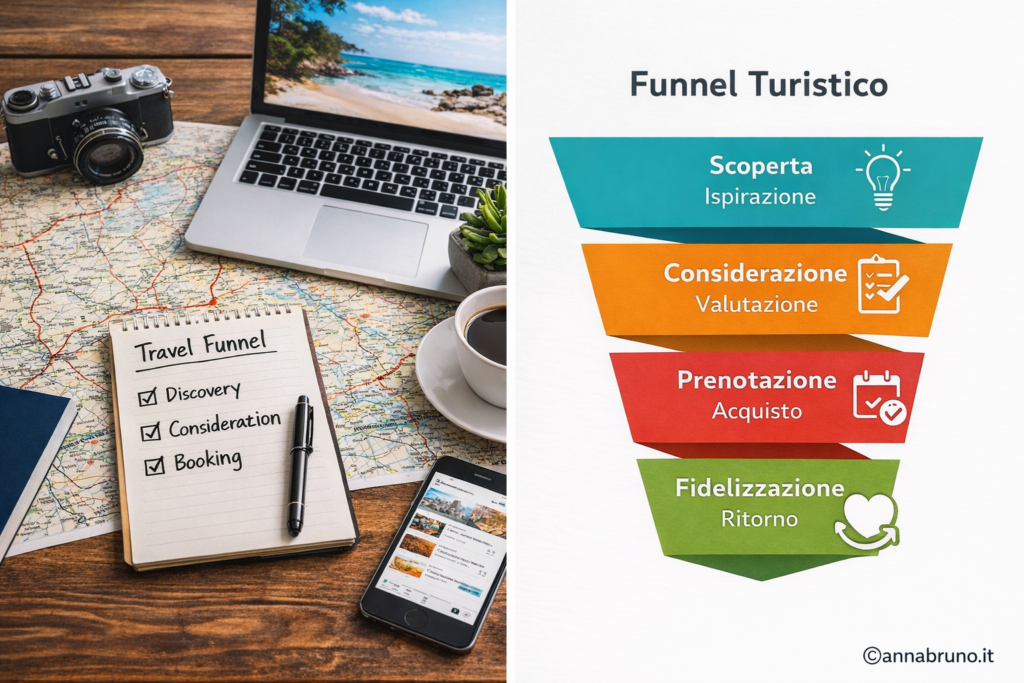
For most projects (tour operators and DMOs) the funnel is divided into three main stages, plus a crucial fourth one for those focusing on the region and reputation.
Discovery (inspiration, desire, “I want to know more”).
Consideration (evaluation, comparison, “is this right for me?”).
Booking (conversion, “how and when do I buy it?”).
Phase 1: discovery (here, the goal is not to sell)
When the traveler is exploring, they’re not looking for a “Book now” button. They’re searching for an image, an idea, a reason to choose that particular place or experience. It’s an emotional phase, but not a “soft” one: this is when they decide if you’ll even enter their radar or not.
What works for a DMO
Inspirational content with a point of view – not just “what to see”, but “why it’s worth going” (seasons, atmospheres, identity).
Evergreen guides aimed at search – pages that answer real questions and remain useful over time (informational SEO).
Storytelling of experiences – experiences told with concrete details (what you do, how long it lasts, who it’s for, what to expect).
What works for a tour operator
Thematic “discovery” itineraries – content that opens up possibilities (e.g., food & wine, villages, nature, events, wellness), without forcing the sale right away.
Video and immersive content – useful not to “entertain”, but to help people imagine what the actual experience will be like.
Essential lead magnet – a brief guide or a checklist that allows you to collect contacts and build a relationship.
Typical mistake: asking for the booking too soon. In the discovery phase, the best CTA is often not “book”, but save, subscribe, download, get the itinerary.
Phase 2: consideration (the most underrated phase)
Here the traveler is comparing. If you’re a DMO, they’re not comparing “you” with a direct competitor: they’re comparing opportunities, seasons, costs, logistics e perceived risks. If you are a tour operator, compare similar offers (and often decide based on clarity and trust rather than price).
What the user needs to find at this stage
Operational clarity – what’s included, what isn’t, how to get there, timing, level of difficulty, who it’s suitable for.
Proof of reliability – reviews, testimonials, real photos, transparent policies, presence of support.
Reduction of uncertainty – well-written FAQs, answers to recurring doubts, examples of a typical day.
Content and pages that truly convert (during consideration)
“One choice at a time” landing page – a page for a specific experience or package, with complete information and a consistent CTA.
Detailed itineraries – not just “3-day tour”, but a readable schedule, with pace, stops, and realistic expectations.
Comparison pages – “2 days vs 4 days”, “summer vs autumn”, “families vs couples”: these help the decision process.
AEO-focused FAQs – direct answers to questions users ask Google and conversational AI.
Note for DMOs: consideration is not “just” for tour operators. A DMO can (and should) offer ready-made routes, bookable experiences, and themed collections that simplify the choice, even when not selling directly.
Step 3: booking (frictionless conversion)
If the user reaches this point, most of the work is done. Now you need to avoid losing them over technical details or unnecessary friction. In tourism, conversion is often lost for trivial reasons: procedures too long, lack of trust, too many alternatives at the same spot.
Requirements of an effective booking page
A single main action – either book, or request info: not both with equal weight. Dual CTA causes confusion.
Essential information above the fold – price (or “from”), duration, what’s included, dates/periods, availability, contact.
Quick contact channel – WhatsApp or phone (if consistent with the brand and target audience), especially for high-value sales.
The frictions I see most often (and that cost bookings)
Booking engine not very readable – not optimized for mobile, too many fields, unclear errors, slow loading.
Missing information – the user has to look elsewhere for details on inclusions, meeting point, transfers, difficulty levels.
No follow-up – request sent and then silence: in tourism, things “cool off” quickly.
Phase 4: post-booking (the value many leave on the table)
This phase is crucial for both tour operators and DMOs because it generates return, word of mouth, and reputation. It’s also the phase where you can increase the average value and satisfaction without “hard selling.”
Preparation content – what to bring, what to expect, weather, clothing, practical tips (reduces anxiety and complaints).
Smart upsell – relevant extra experiences (not “random add-ons”), proposed at the right time.
Reviews and UGC – requesting feedback with a simple and respectful sequence increases the quantity and quality of reviews.
Seasonal return – for DMOs, suggesting “another way to experience it” (autumn/winter) is a powerful lever for destagionalization.
The most common mistakes that block tourism funnels
When a funnel doesn’t work, it’s rarely “the market’s fault.” Almost always, it’s a combination of choices not aligned with the real user decision journey.
Confusing visibility with strategy – more content doesn’t mean more bookings if structure is missing.
Speaking to everyone in the same way – families, couples, seniors, and active travelers don’t decide based on the same criteria.
Not tracking – without minimum data, you don’t understand where you’re losing users (discovery, consideration, or booking).
Not addressing objections – a user who doesn’t find clear answers leaves, they don’t “wait.”
Inconsistent CTAs – “book” on discovery content, “discover” on conversion pages: the funnel breaks.
The method I use to build a tourism funnel (tour operators and DMOs)
When I design a funnel, I never start with the platform or the ads. I start with the people and the journey. The method is replicable and can be adapted even for small budgets.
Real audience analysis – needs, objections, selection criteria, decision timelines.
Touchpoint mapping – where they discover, how they seek information, what they look for before deciding.
Content architecture by stage – what you publish in the discovery phase, what in consideration, what in conversion.
Landing and journey design – pages that reduce friction and accompany the action.
Measurement and optimization – a few clear KPIs (not a thousand metrics), periodic reviews and incremental improvements.
Tourism funnels and AEO: why AI optimization matters today
Discovery no longer happens only on “classic” Google. More and more people use conversational tools to ask for advice, comparisons, and directions. This changes one thing: your content must be answers, not just storytelling.
An up-to-date funnel must include:
FAQ and direct answers – short, precise, with actionable details.
Decision-oriented content – not just “what to do,” but “what’s best to choose” based on the traveler’s profile.
Tourism funnel FAQs (AEO)
What is a tourism funnel?
It is a strategic journey that guides the traveler from discovery to booking, using different content and pages depending on the phase of the customer journey.
Are tourism funnels only for tour operators?
No. They are also useful for DMOs, consortia, territorial networks, and local operators, because they help turn interest into concrete actions (inquiries, bookings, visits, experiences).
Can you build a funnel without advertising?
Yes. A funnel can be based on SEO and evergreen content. Advertising speeds things up and amplifies, but it only really works if the journey is already well designed.
What is the most common mistake?
Creating “beautiful” content without deciding what action it should generate and without building a logical transition from one phase to the next.
The thing I always tell clients
The problem isn’t “we don’t have enough bookings.” Often, the issue is that there’s no pathway guiding the decision. A well-constructed tourism funnel transforms marketing from a cost into an investment: because it makes the journey from interest to conversion both predictable and improvable.
Do you want to create an effective tourism funnel for your destination or tour operator business?
If you feel like your traffic isn’t converting, your campaigns are inconsistent, or your content isn’t generating real inquiries, we can analyze your current customer journey together and find out where it’s breaking down.
Usiamo cookie per ottimizzare il nostro sito web ed i nostri servizi.
Funzionale
Always active
L'archiviazione tecnica o l'accesso sono strettamente necessari al fine legittimo di consentire l'uso di un servizio specifico esplicitamente richiesto dall'abbonato o dall'utente, o al solo scopo di effettuare la trasmissione di una comunicazione su una rete di comunicazione elettronica.
Preferenze
L'archiviazione tecnica o l'accesso sono necessari per lo scopo legittimo di memorizzare le preferenze che non sono richieste dall'abbonato o dall'utente.
Statistiche
L'archiviazione tecnica o l'accesso che viene utilizzato esclusivamente per scopi statistici.L'archiviazione tecnica o l'accesso che viene utilizzato esclusivamente per scopi statistici anonimi. Senza un mandato di comparizione, una conformità volontaria da parte del vostro Fornitore di Servizi Internet, o ulteriori registrazioni da parte di terzi, le informazioni memorizzate o recuperate per questo scopo da sole non possono di solito essere utilizzate per l'identificazione.
Marketing
L'archiviazione tecnica o l'accesso sono necessari per creare profili di utenti per inviare pubblicità, o per tracciare l'utente su un sito web o su diversi siti web per scopi di marketing simili.